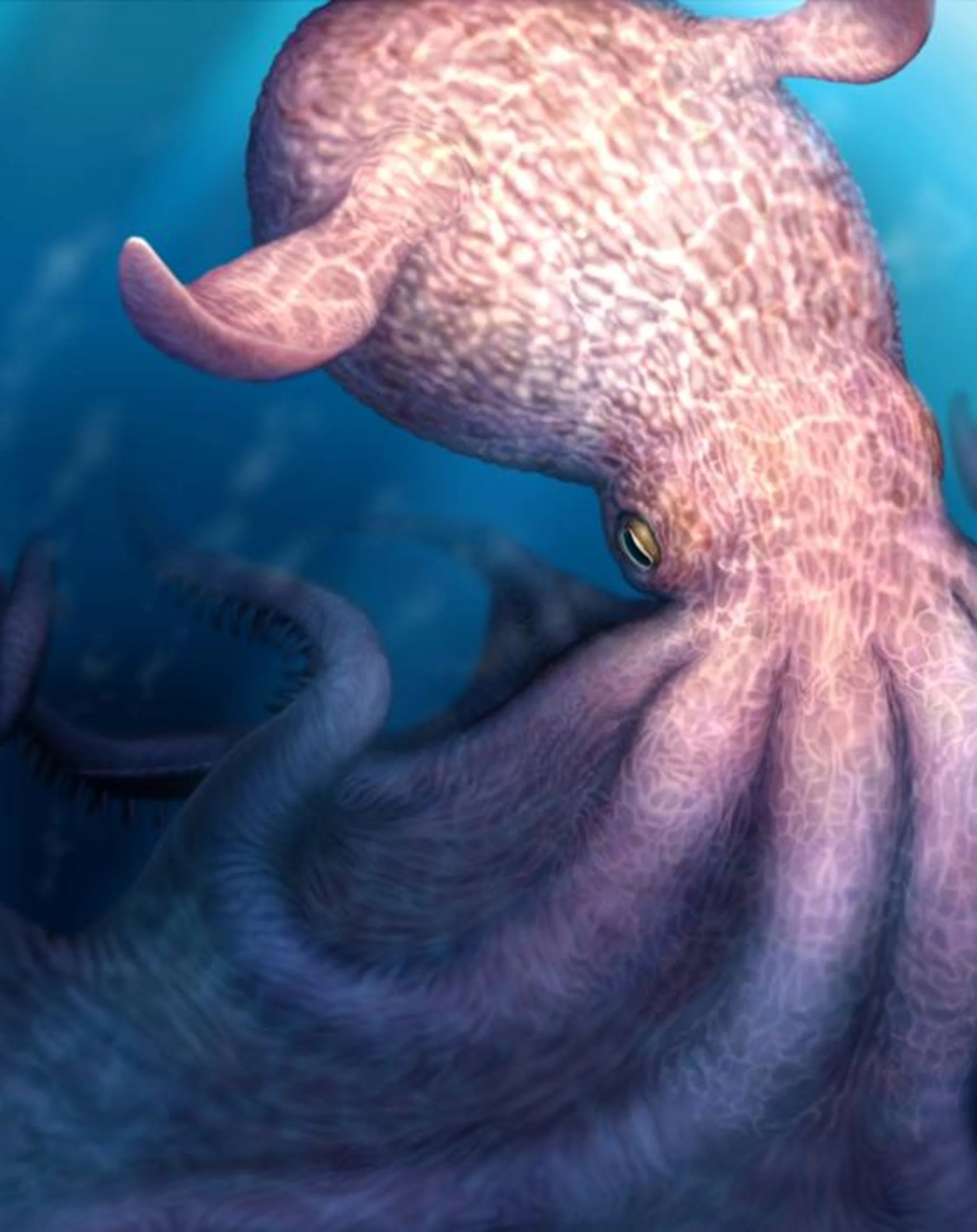
Modern octopuses are known as escape artists of the sea, soft-bodied, elusive, and almost impossible to pin down. But a new fossil discovery is challenging that familiar image. Hidden inside ancient rocks, scientists have found rare clues that suggest the early story of octopuses may have been far more dramatic than anyone expected.
Image Credit: Yohei Utsuki, Department of Earth and Planetary Sciences, Hokkaido University
How do you find a soft animal in the fossil record?
Octopuses are difficult animals for palaeontologists to study because their bodies are soft. Unlike creatures with bones or shells, they usually decay before they can be preserved. That has left big gaps in the story of how octopuses evolved.
Researchers led by Hokkaido University turned to one part of the animal that had a better chance of surviving: the jaws. These feeding structures can fossilize more easily than soft tissue, making them valuable clues to ancient behavior.
Using high-resolution grinding tomography and an artificial intelligence model, the team searched inside rock samples from the Late Cretaceous period, dating from 100 to 72 million years ago. The samples came from Japan and Vancouver Island. Hidden within them were fossil jaws preserved in calm seafloor sediments.
Those jaws did more than show that ancient octopuses existed. They kept fine wear marks that offered evidence of how these animals fed.
What did the jaws reveal about these ancient hunters?
The fossils belonged to extinct finned octopuses known as Cirrata. By studying the size, shape, and wear patterns of their jaws, the researchers concluded that these animals were active predators that likely crushed hard prey with powerful bites.
“Our findings suggest that the earliest octopuses were gigantic predators that occupied the top of the marine food chain in the Cretaceous,” says Professor Yasuhiro Iba of Hokkaido University. “Based on exceptionally well-preserved fossil jaws, we show that these animals reached total lengths of up to nearly 20 meters, which may have surpassed the size of large marine reptiles of the same age.”
The wear on the jaws was especially revealing. According to Iba, the fossil jaws showed chipping, scratching, cracking, and polishing, signs that the animals bit hard and often.
“The most surprising finding perhaps was the extent of wear on the jaws,” says Iba.
In well-grown specimens, the team found that as much as 10% of the jaw tip, compared with the total jaw length, had been worn away. Iba said this was greater than what is seen in modern cephalopods that eat hard-shelled prey. The researchers interpreted this as evidence of repeated, forceful contact with prey and a more aggressive feeding strategy than expected.
In other words, these were not passive animals waiting for scraps. The fossils point to powerful, active hunters.

Could behavior be fossilized too?
One of the most intriguing clues came from uneven wear. In the two species examined, one side of the biting surface was more worn than the other. That suggests the animals may have used one side of the jaw more heavily.
This kind of uneven preference is called lateralization. In modern animals, it is often linked with advanced neural processing. The study suggests that even these early octopuses may already have shown complex behavior connected to intelligence.
The discovery also pushes back the known history of octopuses. The new fossils extend the earliest known record of finned octopuses by around 15 million years and the broader octopus record by around 5 million years, placing octopuses as far back as about 100 million years ago.
That matters because ancient marine ecosystems have often been viewed as places where vertebrate predators dominated, while invertebrates stayed lower in the food web. These fossils suggest a different picture: giant octopuses may have been an exception, invertebrates that reached the top tier and competed with large vertebrates.
“This study provides the first direct evidence that invertebrates could evolve into giant, intelligent apex predators in ecosystems that have been dominated by vertebrates for about 400 million years. Our findings show that powerful jaws and the loss of superficial skeletons, common characteristics of octopuses and marine vertebrates, were essential to becoming huge, intelligent marine predators” says Iba.
The study, published in Science on 23 April 2026, also points to a new way of exploring the past. By combining digital fossil-mining with AI, the researchers expect to find more hidden fossils inside rocks that may have been overlooked.
The main lesson is simple but striking: the early history of octopuses may have been much larger, fiercer, and more complex than scientists once thought. Somewhere in Cretaceous seas, long before today’s octopuses became masters of escape, their ancient relatives may have been among the animals others had reason to avoid.
If you are interested in more details about the underlying research, be sure to check out the paper published in the peer-reviewed journal Science, listed below this article.
Sources, further reading and more interesting articles:
The Proto-Wing Puzzle: How Dinosaurs Shaped the Future of Flight - (Universal-Sci)
Newly discovered tiny dinosaur fossil raises big questions - (Universal-Sci)
Earliest octopuses were giant top predators in Cretaceous oceans - (Science)

Too busy to follow science news during the week? - Consider subscribing to our (free) newsletter - (Universal-Sci Weekly) - and get the 5 most interesting science articles of the week in your inbox
FEATURED ARTICLES: