Far beyond Neptune, where sunlight is weak and temperatures are extremely low, small icy objects drift through the outer Solar System. Most of them are not expected to hold on to much of anything, especially an atmosphere. Their gravity is too weak, and any gas around them should escape or disappear over time.
That is what makes one object, known as (612533) 2002 XV93, very puzzling.
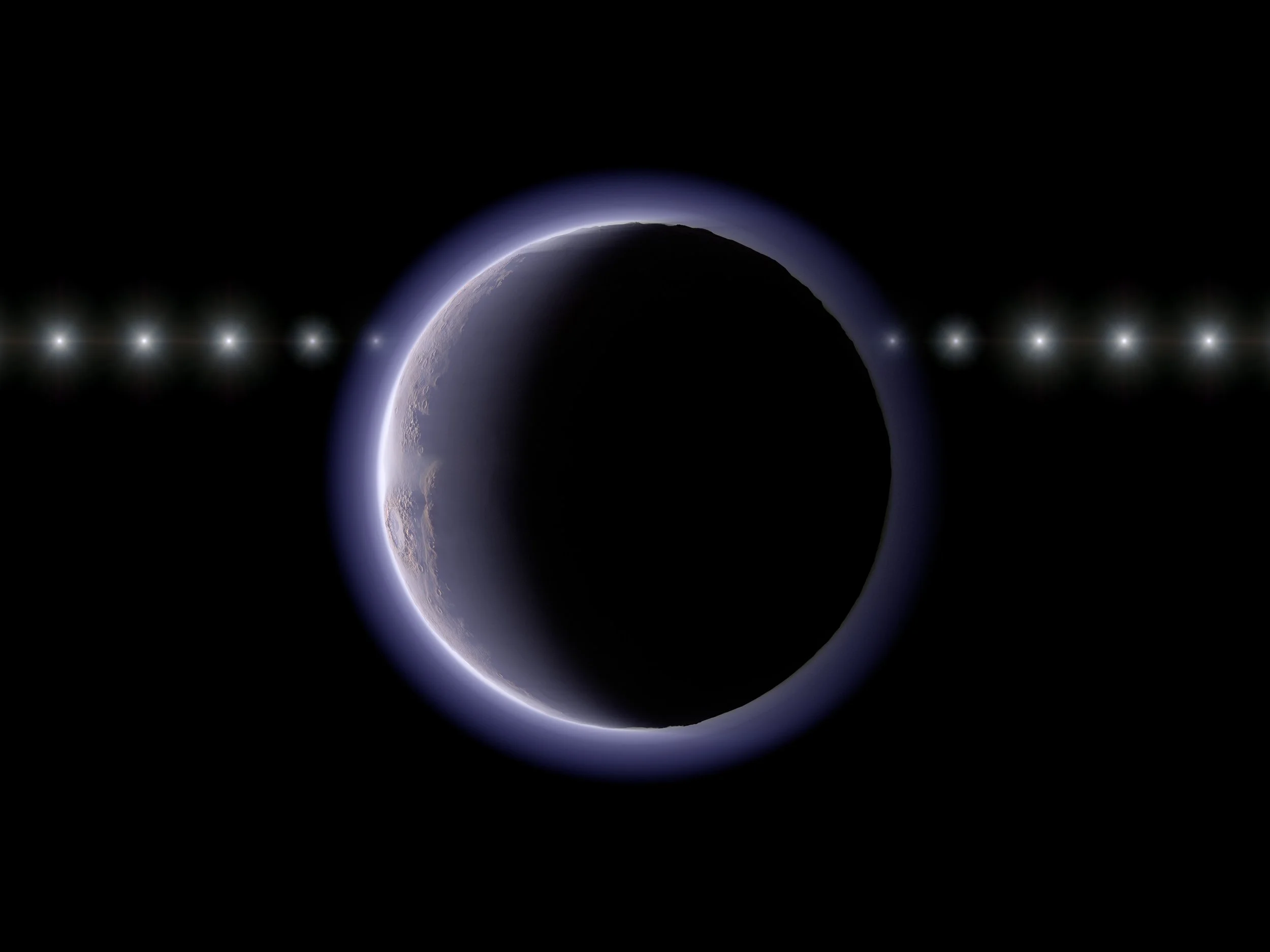
Artist’s illustration depicting an imagined sequence of events as a star passes behind a trans-Neptunian object with an atmosphere. - (Image Credit: NAOJ)
A team of professional and amateur astronomers in Japan has found evidence that this small trans-Neptunian object may be surrounded by a thin atmosphere. The object is only about 500 kilometres across, far smaller than Pluto, which is 2,377 kilometres wide. Yet the observations suggest that 2002 XV93 may have something Pluto is famous for: a layer of gas around it.
The question now is not simply whether the atmosphere is there. It is how such a small, distant body could have one at all.
What happened when a star slipped behind a distant object?
The discovery came from a rare alignment in the sky. On January 10, 2024, as seen from Japan, 2002 XV93 passed directly in front of a star.
This kind of event gives astronomers a useful test. If the object has no atmosphere, the star’s light should disappear suddenly as the solid body blocks it. But if the object has even a thin atmosphere, the star may fade more gradually as its light passes through the gas before being fully blocked.
According to the release, astronomers observed this event from multiple sites in Japan. The team was led by Ko Arimatsu at the NAOJ Ishigakijima Astronomical Observatory, and it included both professional and amateur observers.
The data they gathered were consistent with the star’s light being weakened by an atmosphere around 2002 XV93.
That does not mean the mystery is solved. In fact, it creates a new one.
Why is an atmosphere around 2002 XV93 so unexpected?
2002 XV93 belongs to a group of objects called trans-Neptunian objects, or TNOs. These are bodies that orbit the Sun beyond Neptune. Pluto is the best-known member of this distant population, and astronomers have already observed a thin atmosphere around it.
But Pluto is much larger than 2002 XV93. For most smaller TNOs, conditions are not favourable for keeping an atmosphere. They are cold, and their surface gravity is weak. Any gas around them should be difficult to retain for long.
That is why earlier searches for atmospheres around other TNOs have not produced positive results, according to the release.
2002 XV93 is now different. If the interpretation of the observations is correct, it has a thin atmosphere despite being too small to sustain one for long. Calculations suggest that this atmosphere should last less than 1,000 years unless it is being replenished.
In Solar System terms, that is a very short time. It points to something recent, or something still ongoing.
Where could the gas have come from?
One simple explanation would be that frozen gases on the surface warmed enough to turn directly into gas, a process called sublimation. But the release says observations by the James Webb Space Telescope found no signs of frozen gases on the surface of 2002 XV93 that could supply such an atmosphere.
That leaves other possibilities.
One idea is that frozen or liquid gases from deep inside the object were somehow brought up to the surface. Another is that a comet may have crashed into 2002 XV93, releasing gas and creating a temporary atmosphere.
Both possibilities would point to a recent event in the object’s history. But the current evidence is not enough to choose between them.
Future observations will be needed to better understand the atmosphere and narrow down its origin. Astronomers will want to know what the atmosphere is made of, how dense it is, and whether it changes over time.
For now, 2002 XV93 is a reminder that the outer Solar System is not just a frozen storage room of inactive leftovers. Even small worlds far from the Sun can still surprise us. The main takeaway is simple: this distant object appears to have an atmosphere it should not be able to keep, which means something recent may have happened there, and astronomers now have a new clue to follow.
If you are interested in more details about the underlying research, be sure to check out the paper published in the peer-reviewed journal Nature Astronomy, listed below this article.
Sources, further reading and more interesting articles:
How Large Is The Universe? - (Universal-Sci)
Remarkable Find: Second-Ever Planet Forming Around a Sun-Like Star - (Universal-Sci)
If the Universe Is Expanding, What Is It Expanding Into? - (Universal-Sci)
Could we actually reach a black hole with a paperclip-sized spacecraft? - (Universal-Sci)
How do astronomers know the age of the planets and stars? - (Universal-Sci)
Detection of an atmosphere on a trans-Neptunian object beyond Pluto - (Universal-Sci)

Too busy to follow science news during the week? - Consider subscribing to our (free) newsletter - (Universal-Sci Weekly) - and get the 5 most interesting science articles of the week in your inbox
FEATURED ARTICLES: