

Orbital debris, otherwise known as “space junk”, is a major concern. This massive cloud that orbits the Earth is the result of the many satellites, platforms and spent launchers that have been sent into space over the years. And as time went on, collisions between these objects (as well as disintegrations and erosion) has created even more in the way of debris.
Ever wondered what final approach to Mars might feel like?

We’ve posted several ‘flyover’ videos of Mars that use data from spacecraft. But this video might be the most spectacular and realistic. Created by filmmaker Jan Fröjdman from Finland, “A Fictive Flight Above Real Mars” uses actual data from the venerable HiRISE camera on board the Mars Reconnaissance Orbiter, and takes you on a 3-D tour over steep cliffs, high buttes, amazing craters, polygons and other remarkable land forms. But Fröjdman also adds a few features reminiscent of the landing videos taken by the Apollo astronauts. Complete with crosshatches and thruster firings, this video puts you on final approach to land on (and then take off from) Mars’ surface.
How did Uranus get its name?
The period known as the Scientific Revolution (ca. 16th to the 18th century) was a time of major scientific upheaval. In addition to advances made in mathematics, chemistry, and the natural sciences, several major discoveries were made in the field of astronomy. Because of this, our understanding of the size and structure of the Solar System was forever revolutionized.
Hubble's Glittering Frisbee Galaxy
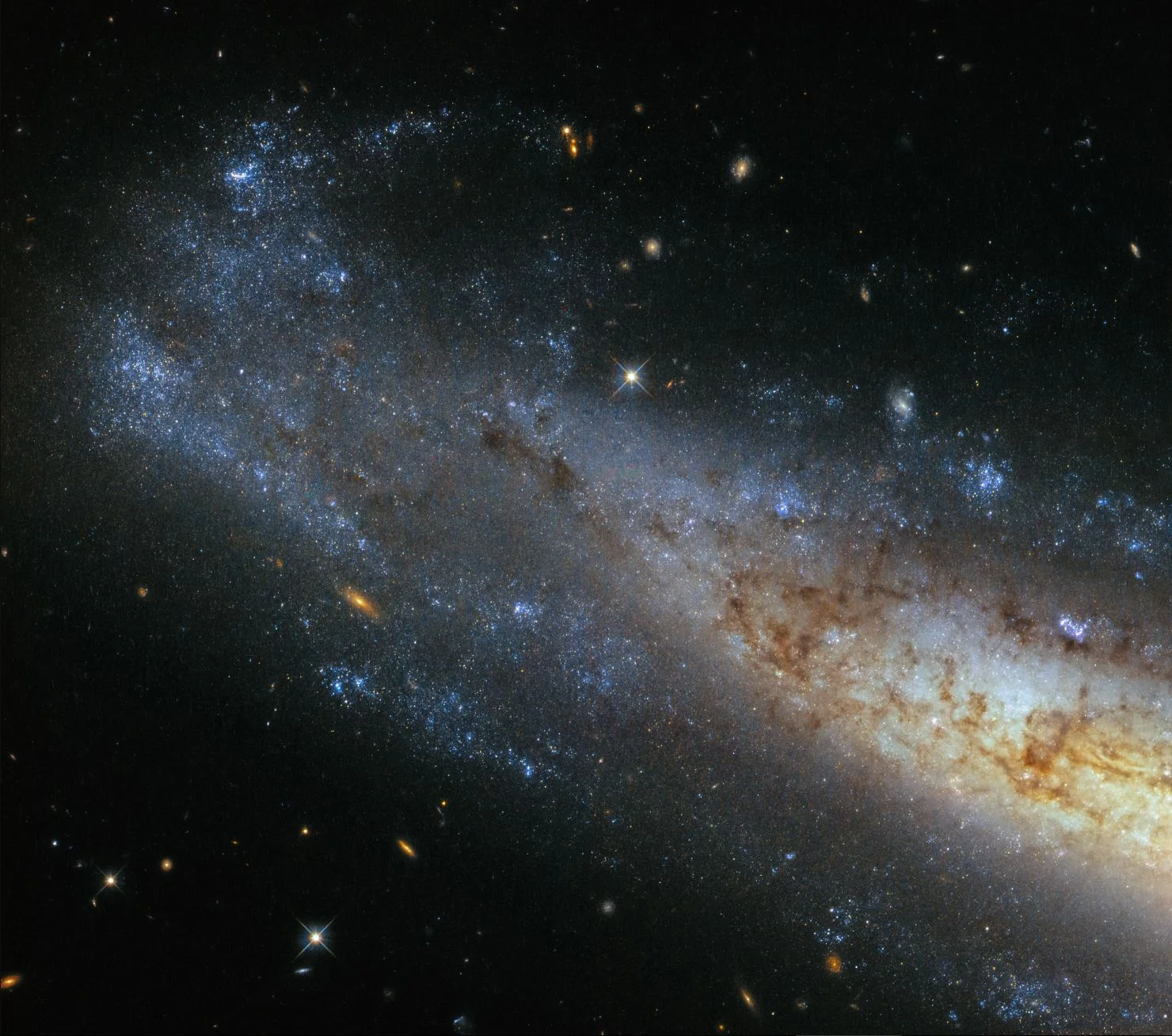
This image from Hubble’s Wide Field Camera 3 (WFC3) shows a section of NGC 1448, a spiral galaxy located about 50 million light-years from Earth in the little-known constellation of Horologium (The Pendulum Clock). We tend to think of spiral galaxies as massive and roughly circular celestial bodies, so this glittering oval does not immediately appear to fit the visual bill. What’s going on?
Health Check: is sleepwalking problematic and can it be ‘cured’?
Does Mars Have Rings? Not Right Now, But Maybe One Day
The brain: a radical rethink is needed to understand it
Understanding the human brain is arguably the greatest challenge of modern science. The leading approach for most of the past 200 years has been to link its functions to different brain regions or even individual neurons (brain cells). But recent research increasingly suggests that we may be taking completely the wrong path if we are to ever understand the human mind.
How far is Venus from the Sun?
Earth and Venus are often called “sister planets” because they share some key characteristics. Like Earth, Venus is a terrestrial planet (i.e. composed of silicate minerals and metals) and orbits within our Sun’s habitable zone. But of course, they are also some major differences between them, like the fact that Venus’ is atmosphere is extremely dense and the hottest in the Solar System.
The science of liquorice: whether you love the dark root – or hate it

How do animals see in the dark?
3.14 essential reads about π for Pi Day
Life on Earth is used to gravity – so what happens to our cells and tissues in space?
There’s one force whose effects are so deeply entrenched in our everyday lives that we probably don’t think much about it at all: gravity. Gravity is the force that causes attraction between masses. It’s why when you drop a pen, it falls to the ground. But because gravitational force is proportional to the mass of the object, only large objects like planets create tangible attractions. This is why the study of gravity traditionally focused on massive objects like planets.
Fried egg? Flying saucer? Nope. Just cool closeups of Saturn's moon Pan
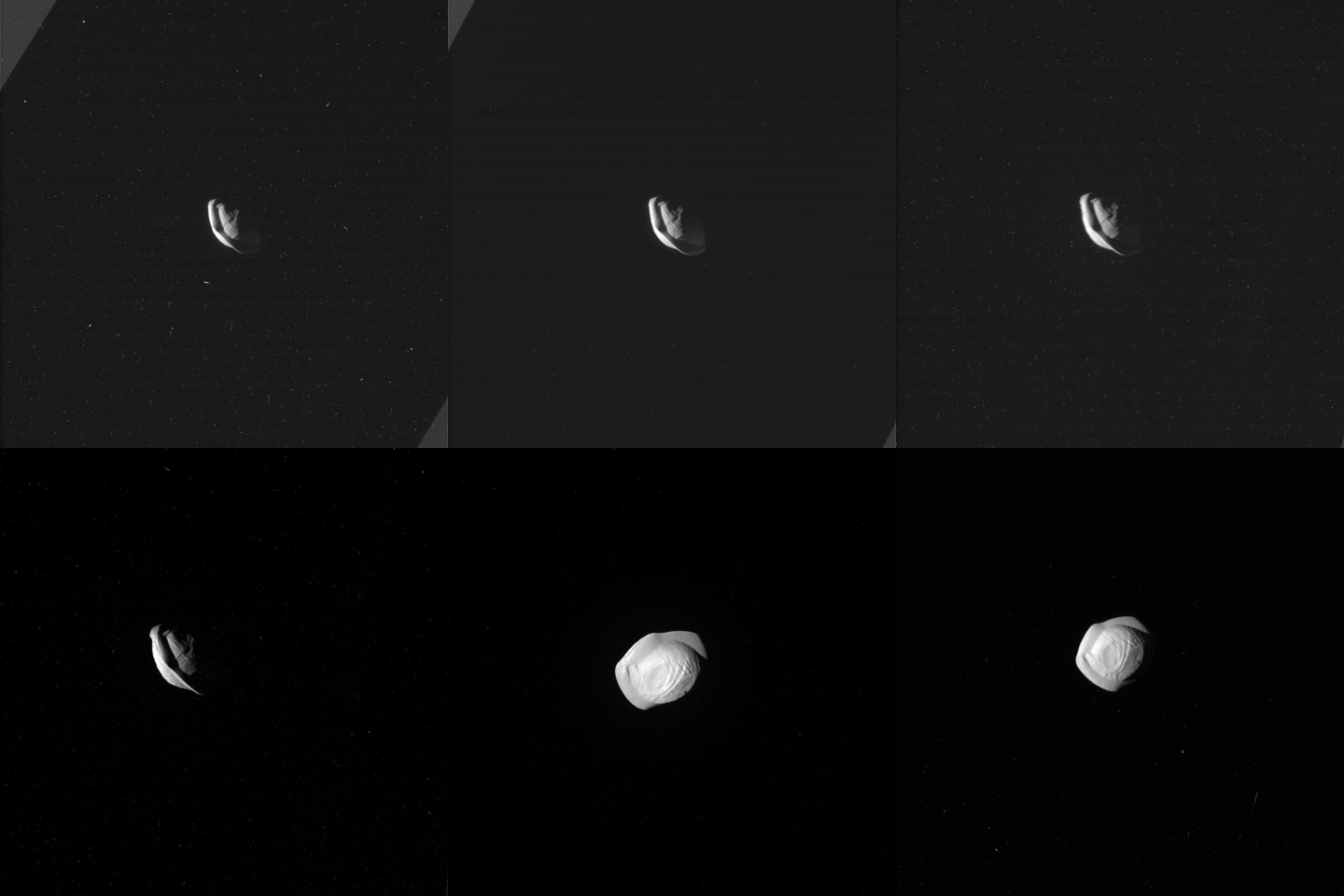
Besides Earth, Saturn may be the only other planet where you can order rings with a side of ravioli. Closeup photos taken by the Cassini probe of the the planet’s second-innermost moon, Pan, on March 7 reveal remarkable new details that have us grasping at food analogies in a feeble attempt to describe its unique appearance.
How long is a day on Mercury

Mercury is one of the most unusual planets in our Solar System, at least by the standards of us privileged Earthlings. Despite being the closest planet to our Sun, it is not the hottest (that honor goes to Venus). And because of its virtually non-existence atmosphere and slow rotation, temperatures on its surface range from being extremely hot to extremely cold.
Comets or volcanoes? Scientists are changing their minds about how the Earth’s water got here
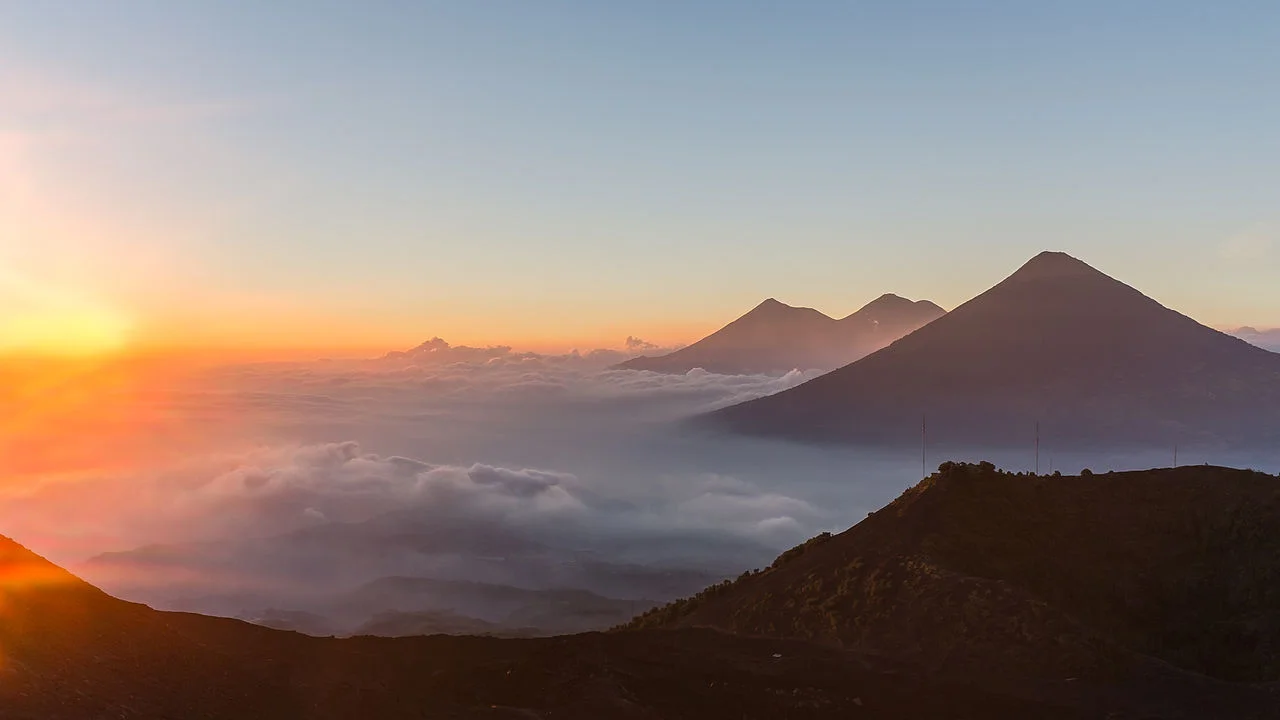
The Earth has been the blue planet for as many as 3.8 billion years. Ancient sedimentary rock deposits and lava that cooled into characteristic pillow shapes provide irrefutable evidence that liquid water has existed at the Earth’s surface for at least this long. But given how many barren rocks there are in the galaxy, Earth’s abundant oceans raise the question of where all that water came from.
Conservation efforts must include small animals. After all, they run the world

When galaxies collide, stars suffer the consequences

When galaxies collide, the result is nothing short of spectacular. While this type of event only takes place once every few billion years (and takes millions of years to complete), it is actually pretty common from a cosmological perspective. And interestingly enough, one of the most impressive consequences – stars being ripped apart by supermassive black holes (SMBHs) – is quite common as well.
Health Check: are naps good for us?

Catnap, kip, snooze, siesta; whatever you call naps, there is no doubt these once frowned-upon short sleeps are gaining acceptance. The increase in popularity is not surprising, with the Centers for Disease Control and Prevention in the US finding around a third of American adults do not get the recommended seven hours sleep each night.
A Galaxy on the Edge
This colourful stripe of stars, gas, and dust is actually a spiral galaxy named NGC 1055. Captured here by ESO’s Very Large Telescope (VLT), this big galaxy is thought to be up to 15 percent larger in diameter than the Milky Way. NGC 1055 appears to lack the whirling arms characteristic of a spiral, as it is seen edge-on. However, it displays odd twists in its structure that were probably caused by an interaction with a large neighbouring galaxy.
How far is Mercury from the sun?

Mercury is famously known for being a scorching hot world. On the side that is facing towards the Sun, conditions can get pretty molten, reaching temperatures of up to 700 K (427 °C; 800°F) in the equatorial region. The surface is also airless, in part because any atmosphere it could generate would be blown away by solar wind. Hardly surprising, considering it is the closest planet to our Sun.