
For most of astronomy’s history, the death of a massive star has been a loud event. A supernova flares so brightly it can briefly outshine an entire galaxy. But a new study describes something far stranger: a massive star that seemed to fade out of existence, leaving behind only a lingering, heat-like glow.
At first, the data looked like a mystery and even an “oddball.” Then the pattern kept getting harder to ignore. By stitching together more than a decade of observations, astronomers say they have watched a star in the Andromeda Galaxy transition into a black hole, without the fireworks.
The details are where the story gets wild, because the clues were not in visible light at all.
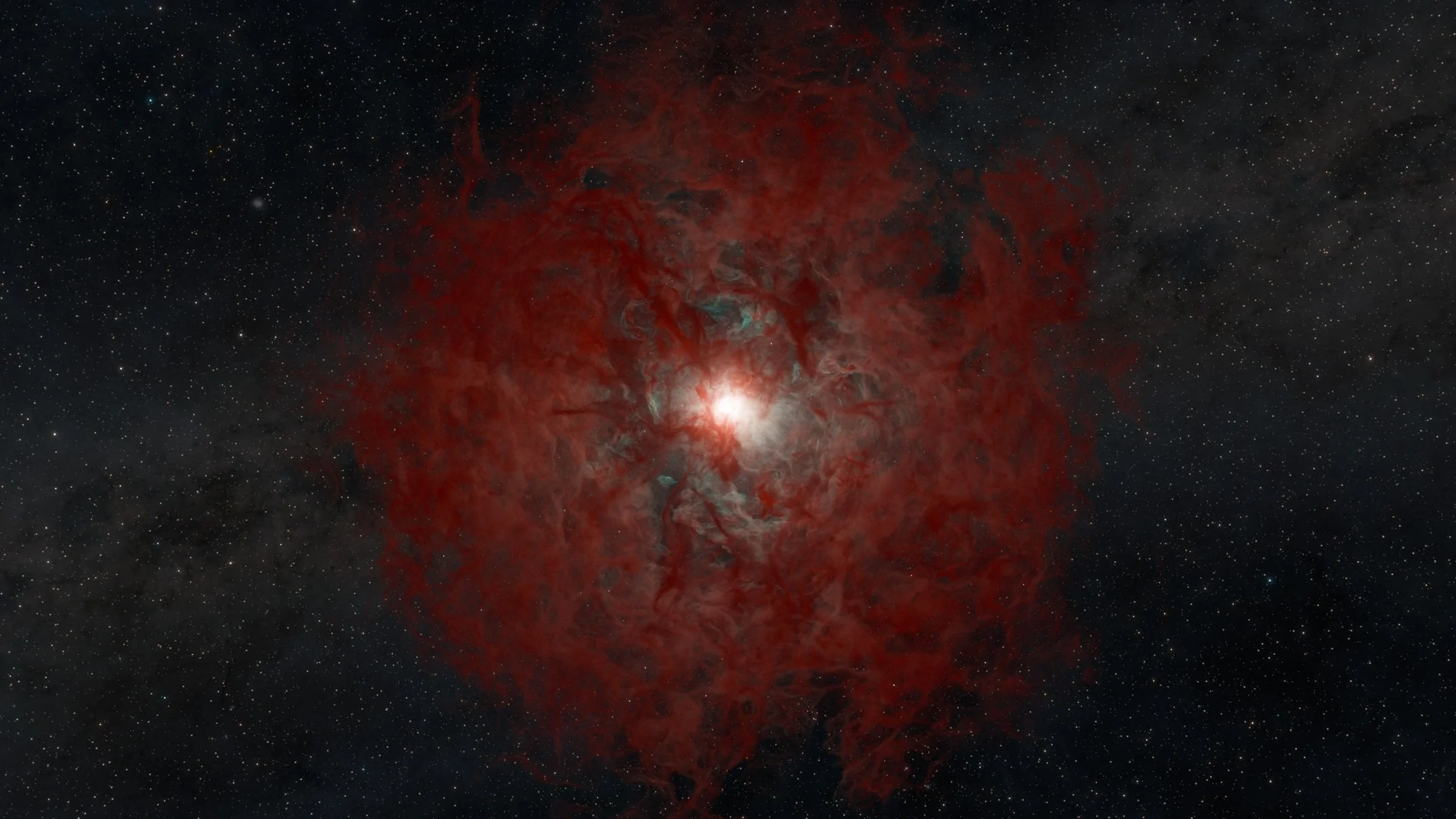
(Image Credit: Keith Miller, Caltech/IPAC - SELab)
The star that got brighter first… then went missing
The star is called M31-2014-DS1, and it sits about 2.5 million light-years away in the Andromeda Galaxy, our Milky Way’s large neighbor. Researchers led by Kishalay De at the Simons Foundation’s Flatiron Institute analyzed measurements taken from 2005 to 2023, including data from NASA’s NEOWISE mission and other telescopes.
Here is the sequence that caught their attention:
2014: the star’s infrared light began to brighten
2016: it dimmed rapidly, dropping far below its earlier brightness in roughly a year
2022 to 2023: it essentially vanished in visible and near-infrared light, becoming one ten-thousandth as bright at those wavelengths
Today, the remnant is only detectable in mid-infrared, shining at about one-tenth of its previous mid-infrared brightness
If you are wondering why infrared matters, think of it like heat-vision. Visible light tells you what is shining. Infrared can reveal warm dust and gas that is glowing even when the original source is hidden.
De summed up just how dramatic the change was: “This star used to be one of the most luminous stars in the Andromeda Galaxy, and now it was nowhere to be seen. Imagine if the star Betelgeuse suddenly disappeared. Everybody would lose their minds! The same kind of thing [was] happening with this star in the Andromeda Galaxy.”
A black hole birth story written in dust and heat
So what could make a giant star fade like that, without a classic supernova blast?
The team’s conclusion is that the star’s core collapsed and became a black hole, while the outer layers did not get blasted away in a single, bright explosion. Instead, the star appears to have shed material more slowly, creating dust that blocks visible light but glows in infrared.
This matters because it lines up with a long-standing idea in stellar physics: sometimes a massive star tries to explode, but the explosion fizzles.
In many supernovae, the collapse of the core produces a flood of tiny particles called neutrinos. That neutrino energy can help drive a shock wave that rips the star apart. But if that shock wave is not strong enough, much of the star’s material can fall inward and help create a black hole.
As De put it: “We’ve known for almost 50 years now that black holes exist, yet we are barely scratching the surface of understanding which stars turn into black holes and how they do it.”
Interesting article: The Black Hole at the Center of the Milky Way Is More Active Than Thought - (Universal-Sci)
What makes this case stand out is not just the conclusion, but the amount of evidence. The researchers describe it as the most complete observational record yet of a star’s transformation into a black hole, giving theorists a rare chance to compare models to real events.
The missing ingredient: why “churning” inside a star changes everything
One of the most interesting parts of this result is what the team says explains the slow, dusty aftermath: convection.
Convection is what happens when hot material rises and cool material sinks. You see it in a pot of boiling water, and stars do something similar on a massive scale. The inside of a star is far hotter than its outer layers, so gas can churn and circulate.
According to the researchers, when the core collapses, that outer gas is still moving fast. That motion can keep a lot of material from dropping straight into the black hole. Instead, some gas can swirl around it, like water circling a drain rather than plunging down instantly. That swirling slows down the feeding process (called accretion) and changes what we can observe.
Co-author Andrea Antoni, a Flatiron Research Fellow, developed theoretical predictions connected to these convection models. In the release, she explains what the observations imply: “the accretion rate (the rate of material falling in) is much slower than if the star imploded directly in. This convective material has angular momentum, so it circularizes around the black hole. Instead of taking months or a year to fall in, it’s taking decades. And because of all this, it becomes a brighter source than it would be otherwise, and we observe a long delay in the dimming of the original star.”
Interesting article: Could we actually reach a black hole with a paperclip-sized spacecraft? - (Universal-Sci)
That slow-motion behaviour helps explain two key things astronomers saw: An infrared brightening first: dust can warm up and glow, even if the star itself is becoming hidden. A long, fading afterglow: if only a small fraction of material keeps falling in over decades, it can power a faint but persistent infrared signal
The team estimates that only about one percent of the original envelope gas is falling into the black hole today, yet it is enough to keep the remnant detectable.
An animation showing a star collapsing into a black hole. The black hole sits at the center but is not directly visible. Around it, a shell of dust expands outward while streams of gas spiral inward, drawn by its gravity.
(Credit: Keith Miller, Caltech/IPAC - SELab)
A clue that links two “vanishing stars” into a new class
While studying M31-2014-DS1, the researchers revisited another famous candidate: NGC 6946-BH1, a star that drew attention about a decade ago for showing signs of a “failed supernova.” In the new paper, they argue that the same general picture can explain both cases, and that M31-2014-DS1 may not be a one-off surprise after all.
De describes the bigger shift in thinking like this: M31-2014-DS1 initially seemed like an “oddball,” but now appears to be part of a wider class of objects that includes NGC 6946-BH1.
If that is right, it suggests astronomers may be able to find more black hole births not by waiting for bright explosions, but by searching for stars that dim suddenly and leave a faint, dusty infrared fingerprint behind.
What happens next and why Webb could keep watching
The story is not over, because the leftover dust and debris should keep glowing in infrared for a long time.
De says, “This is just the beginning of the story,” and adds that the light from the dusty debris “is going to be visible for decades at the sensitivity level of telescopes like the James Webb Space Telescope, because it’s going to continue to fade very slowly. And this may end up being a benchmark for understanding how stellar black holes form in the universe.”
That slow fade is exactly what makes this event so valuable. Instead of a brief flash that ends quickly, this kind of black hole formation can leave a long, measurable trail, giving astronomers years to test ideas about how massive stars die.
Takeaway
A star’s death does not always come with a cosmic boom. Sometimes, it looks more like a magic trick: a brilliant object dims, disappears from view, and quietly leaves behind a black hole plus a dusty glow that only infrared telescopes can see. And in this case, the “how” may come down to something surprisingly familiar: churning motion inside a star that keeps matter swirling, stalling the collapse, and stretching the final act out across decades.
If you are interested in more details about the underlying research, be sure to check out the paper published in the peer-reviewed journal Science, listed below.
Sources, further reading and more interesting articles on the subject of Space & Exploration:
Disappearance of a massive star in the Andromeda Galaxy due to formation of a black hole - (Science)
The Black Hole at the Center of the Milky Way Is More Active Than Thought - (Universal-Sci)
Largest Black Hole Jets Ever Discovered, Spanning the Length of 140 Milky Way Galaxies - (Universal-Sci)
Black holes aren’t totally black, and other insights from Stephen Hawking’s groundbreaking work - (Universal-Sci)
Could we actually reach a black hole with a paperclip-sized spacecraft? - (Universal-Sci)
Too busy to follow science news during the week? - Consider subscribing to our (free) newsletter - (Universal-Sci Weekly) - and get the 5 most interesting science articles of the week in your inbox
FEATURED ARTICLES:


Scientists may have found an explanation for one of the biggest mysteries about ʻOumuamua that baffled astronomers in 2017.