A box of bones does not usually look like a plot twist. But when paleontologists began studying a set of unusually small fossils from Spain, they realized they were dealing with something that did not fit the usual expectations for plant-eating dinosaurs. The animal was small, yes, but the real surprise was what that small body might reveal about how dinosaur lineages changed over time.
Below is what researchers say they have learned so far, and why this new find is already sparking fresh debates about dinosaur family trees, growth, and life in ancient forests.
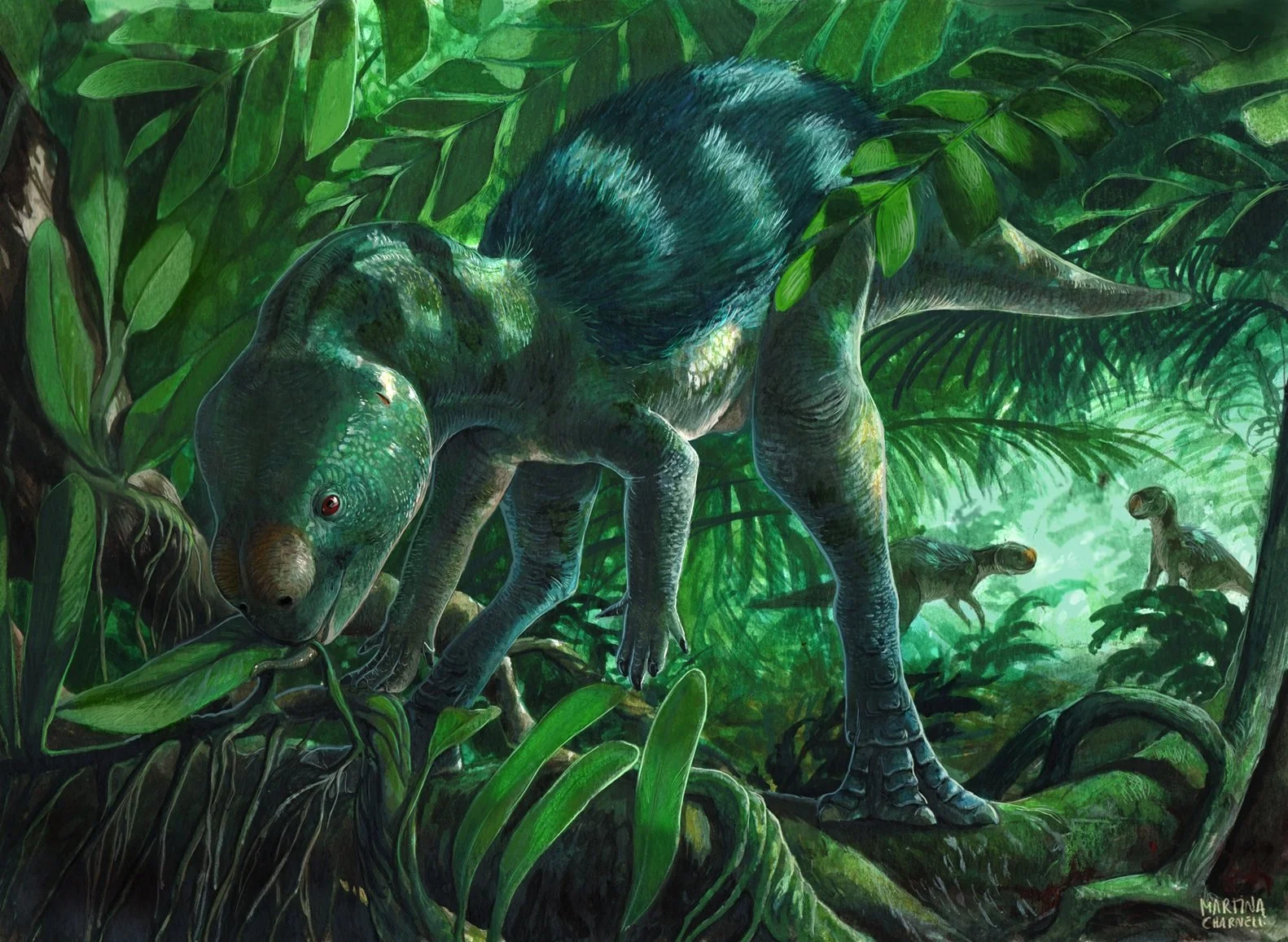
Reconstruction of Foskeia pelendonum - (Image Credit: Martina Charnell via EurekAlert)
A handful of bones that were too small to ignore
The fossils, representing at least five individuals, were first uncovered by Fidel Torcida Fernández-Baldor of the Dinosaur Museum of Salas de los Infantes. “From the beginning, we knew these bones were exceptional because of their minute size. It is equally impressive how the study of this animal overturns global ideas on ornithopod dinosaur evolution,” he notes.
That word, “ornithopod,” covers a wide range of mostly plant-eating dinosaurs. Some ornithopods were fairly large, and many people picture them as sturdy, familiar-looking herbivores. What makes this discovery stand out is that the bones are not just small, they belong to an animal whose anatomy does not neatly match the standard story researchers have used to explain how these dinosaurs evolved.
A name built from “light” and “foraging” and a local tribe
The research team named the dinosaur Foskeia pelendonum, and the name is meant to tell you something about both the animal and the place it comes from.
The genus name Foskeia is derived from the ancient Greek. The prefix fos means “light,” a nod to the very lightweight and small body size of grown individuals (Dieudonné et al. 2023). The combination of letters “skei” derives from boskein, which means foraging.
The species name pelendonum refers to the Pelendones, a Celtiberian tribe from the Fuentes del Duero (north of the province of Soria, southeast of Burgos and perhaps the southeast of La Rioja). In other words, the name links the dinosaur to both its likely lifestyle and the human history of the region where it was found.
A small skull with a long reach into dinosaur family history
Several researchers involved in the study argue that Foskeia matters because of where it lands on the dinosaur family tree, and because its anatomy looks unexpectedly specialized.
According to Marcos Becerra (Universidad Nacional de Córdoba), the key point is that getting smaller does not mean the dinosaur became simpler. He says the skull shows unusual, highly specialized features for its group.
Other team members put the broader impact in even sharper terms. Thierry Tortosa (Sainte Victoire Natural Reserve) adds: “Foskeia helps fill a 70-million-year gap, a small key that unlocks a vast missing chapter.” Tábata Zanesco Ferreira (Universidade Federal do Rio de Janeiro) notes: “This is not a ‘mini Iguanodon’, it is something fundamentally different.” Penélope Cruzado-Caballero (Universidad de La Laguna) concludes: “Its anatomy is weird in precisely the kind of way that rewrites evolutionary trees.”
To check whether the small bones came from juveniles or fully grown adults, the team also turned to histology, the study of microscopic bone structure. Histological studies supervised by Dr. Koen Stein (Vrije Universiteit Brussel) confirm that the largest specimen was a sexually mature adult. “Bone microstructure tells us that at least one individual was an adult… with a metabolic regime approaching that of small mammals or birds. Knowledge of growth and development is essential if we want to compare the anatomy of Foskeia with other species. Young individuals are prone to changes in anatomical features as they grow.” Stein explains.
The team reports that a new phylogenetic analysis places Foskeia as sister to the Australian Muttaburrasaurus within Rhabdodontomorpha and expands the European clade Rhabdodontia. Their dataset also recovers a topology that revives the long-debated Phytodinosauria. “In our results, the plant-eating dinosaurs… form a natural group called Phytodinosauria,” explains Dieudonné. “This hypothesis should be further tested with more data.”
Finally, the study suggests this dinosaur was not just small, but adapted to a specific way of life. Despite its small size, Foskeia shows specialized dentition and evidence of shifting posture during growth, relying on bursts of speed in dense forests. Dieudonné adds: “These fossils prove that evolution experimented just as radically at small body sizes as at large ones. The future of dinosaur research will depend on paying attention to the humble, the fragmentary, the small.”
If those conclusions hold up as more fossils and analyses come in, Foskeia pelendonum could become a reference point for understanding how diverse plant-eating dinosaurs really were, especially in parts of the fossil record where the evidence has been thin.
If you are interested in more details about the underlying research, be sure to check out the paper published in the peer-reviewed science journal Papers in Palaeontology, listed below this article.
Sources, further reading and more interesting articles:
A new rhabdodontomorph from the Lower Cretaceous of Salas de los Infantes - (Papers in Paleontology)
Why were there so many dinosaur species? - (Universal-Sci)
It turns out that the T. Rex must have been even more terrifying than previously thought - (Universal-Sci)
The evidence that shows dinosaurs were in decline for 40 million years before the asteroid hit - (Universal-Sci)
Dinosaur Killing Asteroid Hit in Exactly the Wrong Place - (Universal-Sci)
Research implies Tyrannosaurs lived in social groups - (Universal-Sci)
Too busy to follow science news during the week? - Consider subscribing to our (free) newsletter - (Universal-Sci Weekly) - and get the 5 most interesting science articles of the week in your inbox
FEATURED ARTICLES: