
The Ring Nebula is one of those sky objects people come back to again and again. It looks familiar, it photographs well, and it has been studied for generations. So when researchers pointed a new instrument at it and started turning the data into images, they expected to learn more detail, not to find something that seems to cut right across the scene.
What they saw raises an immediate question: if something this striking was hiding there, why has it been so easy to miss until now?
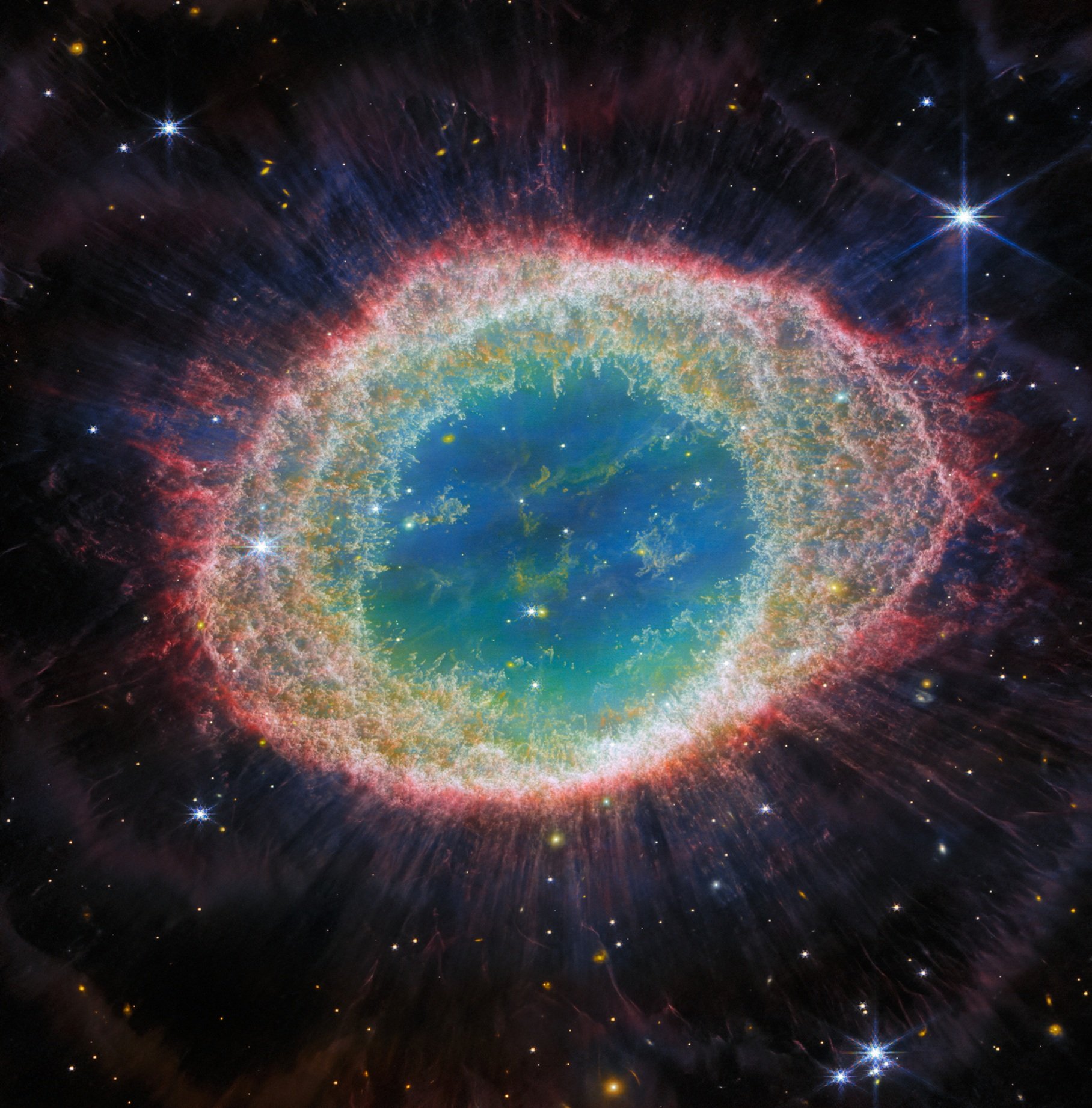
The breathtaking Ring Nebula, lso known as M57 and NGC 6720 - (Image Credit: ESA/Webb, NASA, CSA, M. Barlow, N. Cox, R. Wesson via ESAWebb)
A thin line that does not match the rest of the nebula
A European team led by astronomers at Cardiff University and University College London (UCL) says it has detected a previously unknown, bar-shaped strip of glowing iron inside the Ring Nebula. The feature sits within the nebula’s bright inner region, running across the middle rather than following the familiar ring-like shape.
The Ring Nebula (also known as Messier 57 or NGC 6720) lies in the constellation Lyra and is a classic example of a “planetary nebula,” the expanding gas shell left behind when a Sun-like star sheds its outer layers late in life.
In the team’s description, the iron structure is huge by Solar System standards:
Length: roughly 500 times the size of Pluto’s orbit around the Sun
Iron mass: comparable to the mass of Mars
Location: inside the nebula’s bright inner region, crossing the centre
The discovery is tied to a specific “fingerprint” of iron in the light. In the team’s composite image (described in the release), the bar shows up because of light emitted by four-times-ionised iron (often written as Fe V) at a wavelength of 4227 Angstrom (422.7 nm), while other colours trace different forms of oxygen in the main ring.
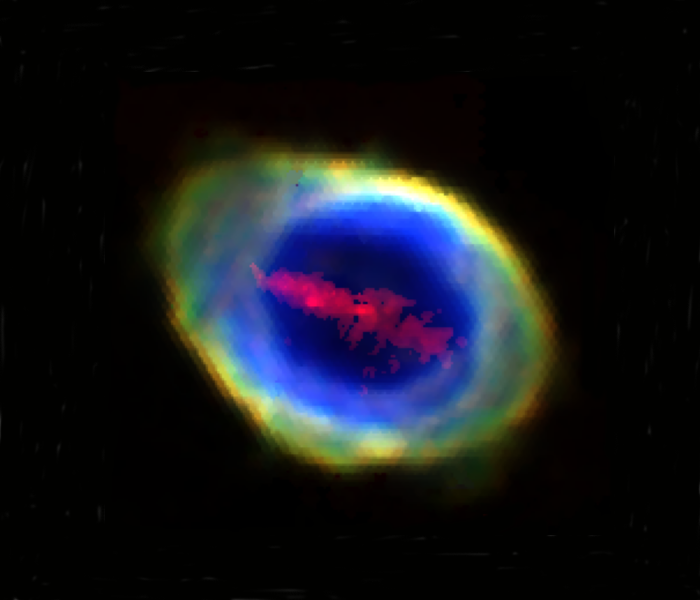
A colour composite of the Ring Nebula built from emission lines measured across the nebula. The outer ring is dominated by glowing oxygen, while a narrow central strip stands out in the light from highly ionised iron. (Image Credit: R. Wesson, Cardiff University/UCL.)
The new kind of “map” that made the iron show up
So how did something like this slip past decades of observations? A big part of the answer is the way the team observed the nebula.
They used a mode called the Large Integral Field Unit (LIFU) on WEAVE, a new instrument on the 4.2-metre William Herschel Telescope on La Palma. Instead of taking a single spectrum from a single point, an integral field unit uses many optical fibres to capture spectra across an area, letting scientists build a “data cube” that contains both the image and the detailed light information at each position.
Lead author Dr Roger Wesson (UCL and Cardiff University) described what that change in approach offers:
“Even though the Ring Nebula has been studied using many different telescopes and instruments, WEAVE has allowed us to observe it in a new way, providing so much more detail than before. By obtaining a spectrum continuously across the whole nebula, we can create images of the nebula at any wavelength and determine its chemical composition at any position.”
In plain terms: if you can measure the spectrum everywhere, you can ask very specific questions later, like “show me only the light from this one iron line,” and then see where it appears across the nebula.
That is when the odd structure became hard to ignore. In the team’s account, the iron emission forms a narrow strip across the nebula’s central region, rather than lining up with the shapes traced by oxygen and other common elements.

Eight maps of the Ring Nebula, each showing light from a different element or type of gas. Warmer colours mean brighter emission. The top-left panel highlights highly ionised iron, which looks very different from the highly ionised argon map at bottom right, even though they usually appear in similar regions.
(Image Credit: R. Wesson, Cardiff University/UCL)
Did the dying star make it, or did something else get shredded?
Right now, the team says it cannot yet explain how the iron bar formed, and it is treating the result as a starting point for follow-up work.
Their release lays out two main possibilities. One is that the iron is a clue to how the star expelled the nebula, suggesting the gas did not leave in a smooth, uniform way and that part of the outflow may have been shaped or heated differently.
The other, more speculative idea is that the iron could be debris from a rocky world, possibly linked to the vaporisation of a planet caught up in the star’s earlier expansion.
Co-author Professor Janet Drew (UCL) urged caution in the release, saying the team needs to learn whether other chemical elements appear in the same place as the iron, because that would help narrow down which explanation makes sense.
The next step is more observing time. The team plans to use WEAVE’s LIFU again, but at higher spectral resolution, to better measure how the gas is moving and to look for additional elements that might travel with the iron.
Dr Wesson also suggests the Ring Nebula may not be the only place this shows up: “It would be very surprising if the iron bar in the Ring is unique,” he said. “So hopefully, as we observe and analyse more nebulae created in the same way, we will discover more examples of this phenomenon, which will help us to understand where the iron comes from.”
WEAVE is scheduled to spend years surveying a wide range of targets, from nearby stars to distant galaxies, which means astronomers will have more chances to spot unusual structures like this in other nebulae.
WEAVE Project Scientist Professor Scott Trager (University of Groningen) summed up what the team hopes comes next: “The discovery of this fascinating, previously unknown structure in a night-sky jewel, beloved by sky watchers across the Northern Hemisphere, demonstrates the amazing capabilities of WEAVE. We look forward to many more discoveries from this new instrument.”
If the iron bar turns out to be common, it could become a new piece of the puzzle in how dying stars recycle material back into space, and possibly in how any surviving planets fare when their star starts to change.
If you are interested in more details about the underlying research be sure to check out the artile published in Monthly Notices of the Royal Astronomical Society, listed below.
Sources, further reading and more interesting articles on the subject of Space & Exploration:
WEAVE imaging spectroscopy of NGC 6720: an iron bar in the Ring - (Monthly Notices of the Royal Astronomical Society)
How Large Is The Universe? - (Universal-Sci)
Remarkable Find: Second-Ever Planet Forming Around a Sun-Like Star - (Universal-Sci)
If the Universe Is Expanding, What Is It Expanding Into? - (Universal-Sci)
Could we actually reach a black hole with a paperclip-sized spacecraft? - (Universal-Sci)
How do astronomers know the age of the planets and stars? - (Universal-Sci)
Too busy to follow science news during the week? - Consider subscribing to our (free) newsletter - (Universal-Sci Weekly) - and get the 5 most interesting science articles of the week in your inbox
FEATURED ARTICLES:


Scientists discovered that the devastating bubonic plague pandemic shaped human evolution and is still affecting our health 700 years later.