
Looking up at the night sky feels like you’re seeing the universe. But physicists say most of it is missing from view. Not missing as in far away, but missing as in invisible.
Scientists estimate that there is about five times as much dark matter as normal matter. That huge unknown is why Dr. Rupak Mahapatra and his team at Texas A&M University are building detectors sensitive enough to spot extremely rare signals, sometimes only once a year or even once in a decade. Their research is featured in the prestigious journal Applied Physics Letters.
Will we finally be able to answer one of astronomy’s hardest questions: what is most of the matter in the universe made of?
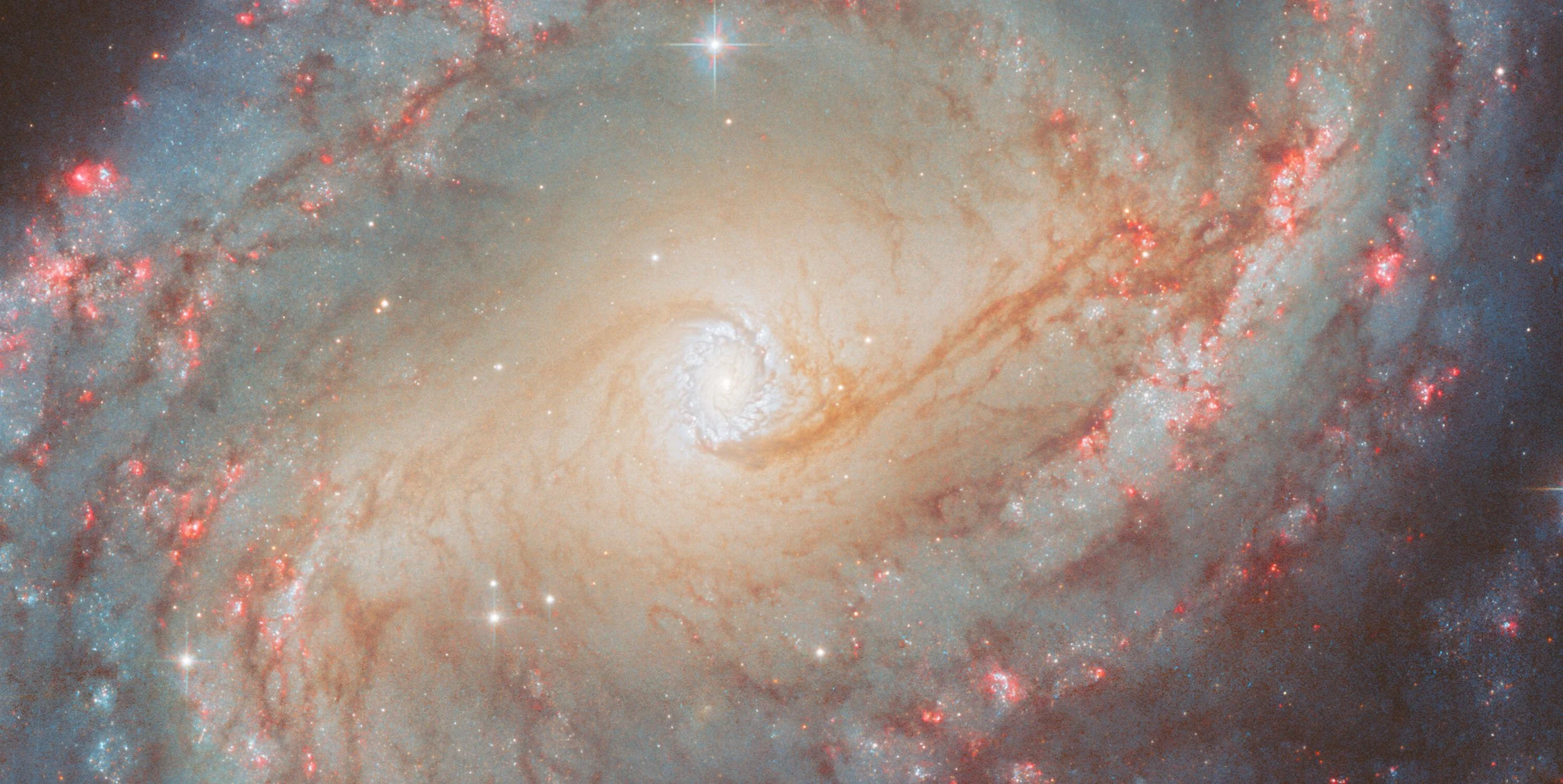
Most astrophysicists believe galaxies would not exist (or at least would not hold their current shapes) without dark matter.
(Image Credit: ESA/Hubble & NASA, L. C. Ho, G. Brammer, A. Filippenko, C. Kilpatrick - via ESA Hubble)
Why do scientists think something invisible is shaping galaxies?
“Dark” in dark matter and dark energy does not mean evil or dangerous. It means unknown.
Dark matter is a name for something that does not emit, absorb, or reflect light, which makes it nearly impossible to observe directly. Yet scientists can see its effects through gravity. Based on how galaxies rotate and how galaxy clusters hold together, researchers infer that there is more mass present than we can account for using visible matter alone.
Dark energy is different. It is the term scientists use for whatever is driving the universe’s accelerating expansion. In everyday language, dark matter acts like extra gravitational glue that helps hold large structures together, while dark energy is associated with the universe stretching faster over time.
Mahapatra compares today’s state of knowledge to a familiar story: “It’s like trying to describe an elephant by only touching its tail. We sense something massive and complex, but we’re only grasping a tiny part of it.”
That is why the tools matter. If you cannot “see” dark matter the normal way, you try to catch the tiny signs it leaves behind when it very rarely bumps into ordinary matter.
How do you listen for a particle that might show up once a decade?
Detecting dark matter is often described as a search for extremely rare events. That is not hype; it is a practical problem.
“The challenge is that dark matter interacts so weakly that we need detectors capable of seeing events that might happen once in a year, or even once in a decade,” Mahapatra said.
To handle that challenge, teams build detectors that are both sensitive and quiet. “Quiet” here means low background noise, not sound. The experiments are designed to reduce the false signals that come from everyday sources like natural radiation, cosmic rays, and tiny vibrations or temperature changes.
Mahapatra’s group contributes to a dark matter search that uses a detector called TESSERACT. According to the release, Texas A&M is part of a select group of institutions working on the TESSERACT experiments. Mahapatra described the approach this way: “It’s about innovation,” he said. “We’re finding ways to amplify signals that were previously buried in noise.”
What Makes These Detectors Sensitive
Advanced "Quantum" Sensors: The detectors use highly advanced semiconductor technology equipped with "cryogenic quantum sensors." These are designed to push the boundaries of what is possible to detect.
Operating at Near Absolute Zero: To work effectively, the detectors are cooled to extremely low temperatures (near absolute zero). This helps them catch rare interactions that would otherwise be missed.
Signal Amplification: The team is using innovative methods to "amplify signals" that were previously hidden by background noise, allowing them to see fainter events than ever before.
Voltage-Assisted Detection: A specific breakthrough mentioned is "voltage-assisted calorimetric ionization detection." In plain terms, this uses voltage to help the detector sense "low-mass" particles that were previously out of reach.
Patience and Endurance: Because dark matter interacts so weakly, the detectors are built to wait for events that might only happen "once in a year, or even once in a decade," requiring long-term stability.
What could we learn if dark matter finally shows itself?
Many experiments focus on a leading dark matter candidate called a WIMP, short for Weakly Interacting Massive Particle. WIMPs are hypothetical particles that, if they exist, would interact through gravity and the weak nuclear force. That would make them hard to detect, but not impossible.
Experiments connected to Mahapatra’s work include SuperCDMS, a long-running dark matter search effort. The release notes that he has participated in SuperCDMS for the past 25 years. It also mentions a 2014 Physical Review Letters paper where he and collaborators introduced voltage-assisted calorimetric ionization detection in SuperCDMS, a technique that improved sensitivity for low-mass WIMPs.
Even with better detectors, researchers do not expect a single project to answer everything. As Mahapatra puts it: “No single experiment will give us all the answers,” Mahapatra notes. “We need synergy between different methods to piece together the full picture.”
Because dark matter is tied to the basic rules of physics on the largest scales. If scientists can identify what it is, it could reshape how we understand particles, forces, and how the universe evolved.
“If we can detect dark matter, we’ll open a new chapter in physics,” Mahapatra said. “The search needs extremely sensitive sensing technologies and it could lead to technologies we can’t even imagine today.”
If you are interested in more details about the underlying research, be sure the read the article publish in the peer-reviewed journal: Applied Physics Letters, listed below.
Sources and further reading on the subject of Space & Exploration:
If the Universe Is Expanding, What Is It Expanding Into? - (Universal-Sci)
Is dark matter older than the big bang? - (Universal-Sci)
How big is the universe? - (Universal-Sci)
How long has gravity existed? - (Universal-Sci)
How do astronomers know the age of the planets and stars? - (Universal-Sci)
How could the Big Bang arise from nothing? (Universal-Sci)
Spontaneous generation of athermal phonon bursts within bulk silicon causing excess noise, low energy background events, and quasiparticle poisoning in superconducting sensors - (Applied Physics Letters)
Too busy to follow science news during the week? - Consider subscribing to our (free) newsletter - (Universal-Sci Weekly) - and get the 5 most interesting science articles of the week in your inbox
FEATURED ARTICLES:




Scientists may have found an explanation for one of the biggest mysteries about ʻOumuamua that baffled astronomers in 2017.