
Any comments, suggestions or just looking for a chat about this subject? Don't hesitate and leave a comment on our comment section down below the article!
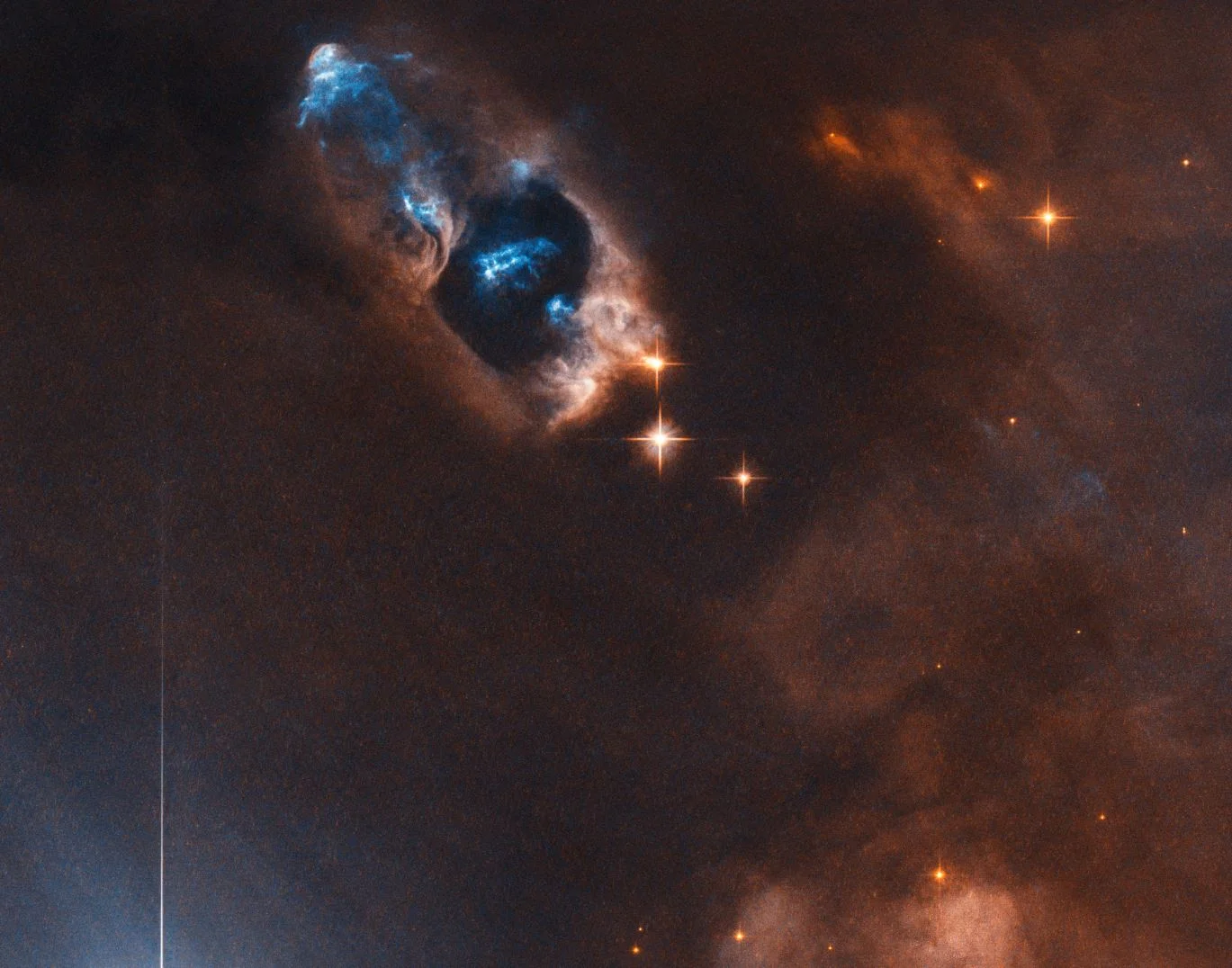
Image credit: ESA/Hubble & NASA, K. Stapelfeldt
In this image, the NASA/ESA Hubble Space Telescope has captured the smoking gun of a newborn star, the Herbig–Haro objects numbered 7 to 11 (HH 7–11). These five objects, visible in blue in the top center of the image, lie within NGC 1333, a reflection nebula full of gas and dust found about a thousand light-years away from Earth.
Bright patches of nebulosity near newborn stars, Herbig-Haro objects like HH 7–11 are transient phenomena. Traveling away from the star that created them at a speed of up to about 150,000 miles per hour, they disappear into nothingness within a few tens of thousands of years. The young star that is the source of HH 7–11 is called SVS 13, and all five objects are moving away from SVS 13 toward the upper left. The current distance between HH 7 and SVS 13 is about 20,000 times the distance between Earth and the Sun.
Herbig–Haro objects are formed when jets of ionized gas ejected by a young star collide with nearby clouds of gas and dust at high speeds. The Herbig-Haro objects visible in this image are no exception to this and were formed when the jets from the newborn star SVS 13 collided with the surrounding clouds. These collisions created the five brilliant clumps of light within the reflection nebula.
Source: NASA press release
If you enjoy our selection of content please consider following Universal-Sci on social media:

With a growing number of Earth-like exoplanets discovered in recent years, it is becoming increasingly frustrating that we can’t visit them. After all, our knowledge of the planets in our own solar system would be pretty limited if it weren’t for the space probes we’d sent to explore them.

With an estimated lifespan of 400 years, the Greenland shark has just been reported to be the longest-lived vertebrate on the planet. This is only the latest of a series of recent findings that push the boundaries of animal longevity, and it raises the perennial question of what factors enable some animals to achieve what we might call extreme longevity – lifespans that can be measured in centuries.
These are the world’s five deadliest volcanoes … and why they’re so dangerous

Scientists working in one of Earth's most extreme habitats, Antarctica, have made some surprising discoveries.
Scientists have long tried to explain the origin of a mysterious, large and anomalously cold region of the sky. In 2015, they came close to figuring it out as a study showed it to be a “supervoid” in which the density of galaxies is much lower than it is in the rest of the universe. However, other studies haven’t managed to replicate the result.

A team of scientists reviewed the merits of fungi-derived leather substitutes, and the results are promising.

Low energy efficiency is already a major problem for petrol and diesel vehicles. Typically, only 20% of the overall well-to-wheel energy is actually used to power these vehicles. The other 80% is lost through oil extraction, refinement, transport, evaporation, and engine heat. This low energy efficiency is the primary reason why fossil fuel vehicles are emissions-intensive, and relatively expensive to run.

Many people wonder why they’re not losing weight when they follow a strict diet and exercise routine.
With a growing number of Earth-like exoplanets discovered in recent years, it is becoming increasingly frustrating that we can’t visit them. After all, our knowledge of the planets in our own solar system would be pretty limited if it weren’t for the space probes we’d sent to explore them.
With an estimated lifespan of 400 years, the Greenland shark has just been reported to be the longest-lived vertebrate on the planet. This is only the latest of a series of recent findings that push the boundaries of animal longevity, and it raises the perennial question of what factors enable some animals to achieve what we might call extreme longevity – lifespans that can be measured in centuries.
These are the world’s five deadliest volcanoes … and why they’re so dangerous
Scientists working in one of Earth's most extreme habitats, Antarctica, have made some surprising discoveries.
Scientists have long tried to explain the origin of a mysterious, large and anomalously cold region of the sky. In 2015, they came close to figuring it out as a study showed it to be a “supervoid” in which the density of galaxies is much lower than it is in the rest of the universe. However, other studies haven’t managed to replicate the result.
A team of scientists reviewed the merits of fungi-derived leather substitutes, and the results are promising.
Low energy efficiency is already a major problem for petrol and diesel vehicles. Typically, only 20% of the overall well-to-wheel energy is actually used to power these vehicles. The other 80% is lost through oil extraction, refinement, transport, evaporation, and engine heat. This low energy efficiency is the primary reason why fossil fuel vehicles are emissions-intensive, and relatively expensive to run.

In the past few decades, there has been an explosion in the number of extra-solar planets that have been discovered. As of April 1st, 2018, a total of 3,758 exoplanets have been confirmed in 2,808 systems, with 627 systems having more than one planet. In addition to expanding our knowledge of the Universe, the purpose of this search has been to find evidence of life beyond our Solar System.
Our own galaxy, the Milky Way, is dotted with fascinating star-forming regions. Some galaxies can produce hundreds of new stars in a single year, and individual galaxies can contain many billions of stars. But why is it that some galaxies stop making new stars?
Many people wonder why they’re not losing weight when they follow a strict diet and exercise routine.