
Something unusual is happening in the Mediterranean Sea, and it goes far beyond the changes scientists have been tracking at the surface. New research reveals a shift unfolding across the basin at surprising depths, raising fresh questions about what it could mean for the sea’s future.

Image Credit: Flystock via Shutterstock / HDR tune by Universal-Sci
The Mediterranean Sea has been getting warmer for decades. But temperature alone is no longer the most striking part of the story.
A new study finds that both warming and rising salinity are accelerating across much of the Mediterranean, with significant changes extending thousands of meters below the surface. In some places, the transformation reaches all the way to the seafloor.
That raises a bigger question: what happens when rapid changes at the surface begin reshaping the deep waters that help circulate oxygen and heat through an entire sea?
The change is no longer just a surface story
Scientists already knew that the Mediterranean was warming. In recent years, its upper 100 meters have been about 2 degrees Celsius warmer than the average recorded between 1950 and 1999.
Previous research had also suggested that surface warming was speeding up. What was less clear was whether the same acceleration was happening deeper down and across the Mediterranean as a whole.
Physical oceanographers Elena Terzić and Ivica Vilibić of the Ruđer Bošković Institute had already found unusual changes in the southern Adriatic. Deep waters there were becoming warmer and saltier, while unusually salty surface waters were appearing across parts of the Mediterranean where they had not historically been common.
Those observations led them to look at the bigger picture.
"We had seen notable changes in our recent studies, both in the deep Adriatic and at the sea surface, and we wanted to quantify the changes across the rest of the Mediterranean," Terzić said.
The researchers combined temperature and salinity measurements collected by scientific cruises and robotic floats between 1950 and 2025.
What they found was not simply a continuation of a long-running trend.
Temperature and salinity are increasing across almost the entire Mediterranean, and in many places the rates of change are themselves increasing.
Since 2000, surface waters have warmed by around 0.5 degrees Celsius per decade. That is roughly two to three times the rate of warming at the surface of the global ocean. During much of the second half of the 20th century, warming across most of the Mediterranean was below 0.1 degrees per decade.
In some regions, the rate of warming is accelerating by as much as 0.3 degrees Celsius per decade with each passing decade. The rate at which the water is becoming saltier is accelerating too.
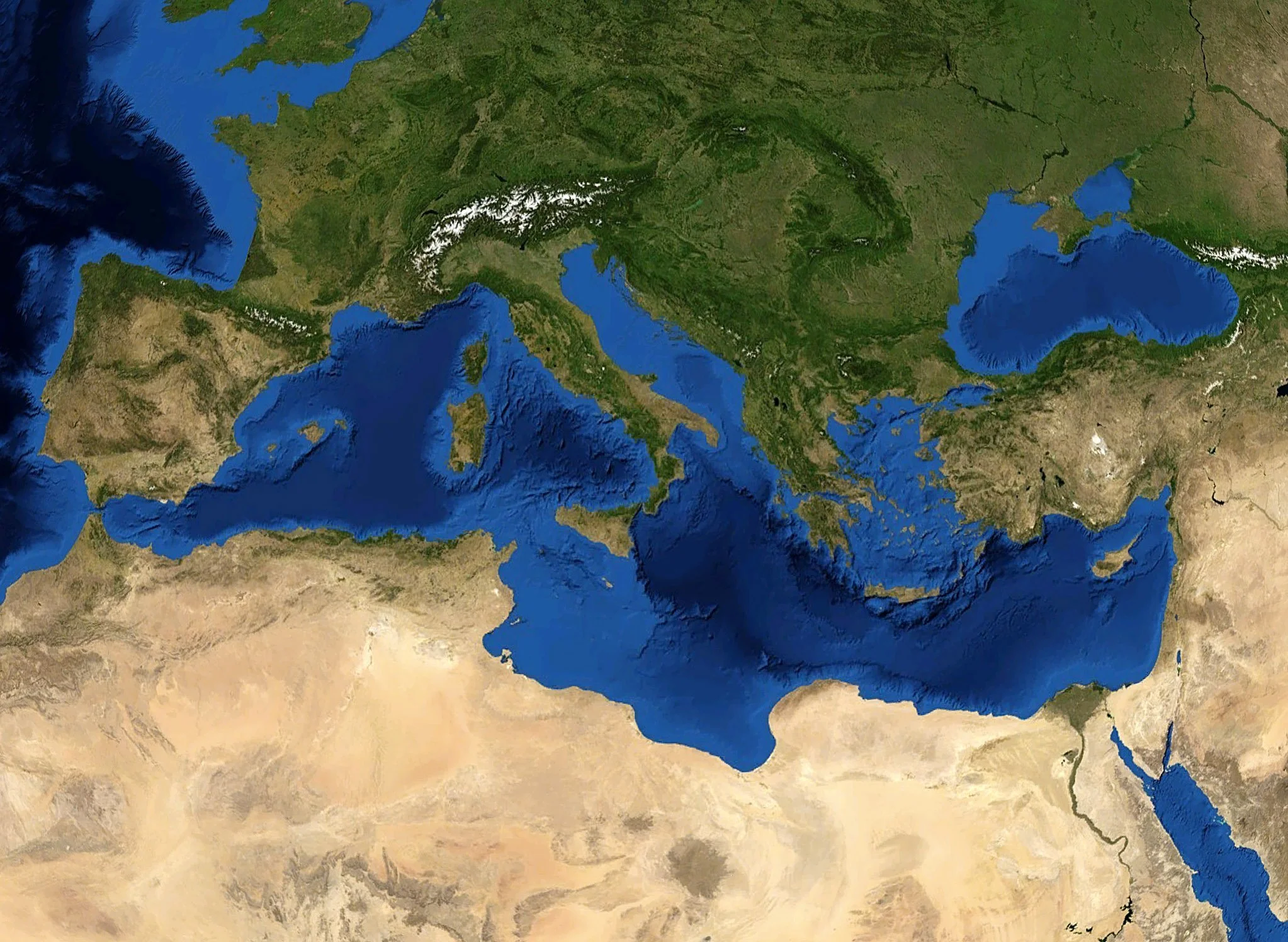
The Mediterranean sea from above - Image Credit: NASA World Wind / Eric Gaba via Wikimedia)

The changes are especially strong in the central and eastern Mediterranean, and most pronounced in the Adriatic.
"What is really surprising is that we see significant changes in every region, reaching great depths," Terzić said.
The researchers found statistically significant warming and rising salinity as deep as 3,000 to 4,000 meters. The acceleration itself could be detected down to roughly 2,500 meters.
"For us, what was alarming was the rate at which this is changing, and the depths that such significant changes reach," Terzić said.
Why warmer and saltier water creates a complicated balance
Temperature and salt do not affect seawater in the same way.
Warmer water is generally less dense, making it lighter. Saltier water is denser, making it heavier. Because Mediterranean waters are becoming both warmer and saltier, the two effects partly counteract each other.
Across much of the basin, warming is having the stronger influence near the surface. That makes surface water lighter and less likely to mix with deeper water.
But the Adriatic behaves differently, and that makes it particularly important.
Cold winter winds can cool surface waters there until they become dense enough to sink. These dense waters then spread into the central and eastern Mediterranean, helping drive deep circulation and carrying oxygen into the depths.
For now, increasing salinity is helping the water remain dense enough to sink despite the warming.
But the water being sent downward is changing.
Since 2000, deep water in the southern Adriatic has warmed about six times faster than deep water in a typical Mediterranean basin. As long as the effect of added salt continues to outweigh the effect of higher temperatures, this water can keep sinking. When it does, however, it carries more heat into the deep Mediterranean.
"Dense water is still forming, but we have indications that the way it forms is changing, and the water that sinks is now warmer and saltier than it used to be," Terzić said.
Whether that balance can continue is still uncertain.
The consequences could extend beyond temperature. The study did not measure oxygen, but warmer water can hold less oxygen, and declining oxygen levels have already been documented in parts of the Mediterranean.
Marine species also face fewer places to escape rising temperatures. The Mediterranean is geographically closed to the north, while the new findings show that deeper water cannot necessarily provide a cool refuge either.
A small sea may be showing what faster ocean change looks like
The Mediterranean is unusual in one important respect: its waters circulate between the surface and the depths around 10 times faster than those of the open ocean.
That makes it especially responsive to changes in the climate.
Globally, the oceans have absorbed more than 90% of the excess heat trapped by greenhouse gases, as well as more than a quarter of human carbon dioxide emissions. By taking up so much heat and carbon, the oceans have moderated changes in Earth's climate.
The Mediterranean may offer a relatively fast-moving example of what that pressure can do to a body of seawater.
Because its circulation is so rapid, changes that could take far longer to emerge in a large ocean basin may become visible there on timescales researchers can directly observe.
The findings also suggest that assuming steady, linear change may underestimate how quickly marine conditions can shift. If the rate of warming and salinification continues to accelerate rather than remaining constant, future conditions could arrive faster than projections based on simpler trends would suggest.
The next task is understanding why the acceleration is happening.
Terzić and Vilibić want to separate the influence of several possible drivers, including changes in the atmosphere, evaporation, rainfall, river discharge and the Atlantic water entering through the Strait of Gibraltar. They also plan to examine whether current climate models reproduce the acceleration seen in the observations.
That matters because those models are used to estimate how the Mediterranean could change in the future.
The study ultimately shows that the transformation of the Mediterranean is not confined to a thin layer at the surface. Warmer, saltier water is appearing across the basin and at remarkable depths, while the pace of change itself is increasing.
"The Mediterranean is small enough that we can watch how a sea responds, on timescales we can witness ourselves, and what we see is unprecedented change," Terzić said.
For scientists, the Mediterranean therefore offers more than a regional case study. It is a place where changes in ocean heat, salinity and circulation can be watched unfolding from the surface almost to the seafloor, offering an unusually clear view of how quickly a warming sea can transform.
If you are interested in more details about the underlying research, be sure to check out the paper published in Geophysical Research Letters, listed below.
Sources and further reading:
We've Barely Seen the Deep Ocean, And Here's Why That Matters - (Universal-Sci)
Vital for life, heat and power: what you never knew about salt water- (Universal-Sci)
Hothouse Earth: our planet has been here before. Here's what it looked like - (Universal-Sci)
How many undiscovered creatures are there in the ocean? - (Universal-Sci)
Observational evidence for accelerated warming and salinification propagating into the deep Mediterranean- (Geophysical Research Letters)

Too busy to follow science news during the week? - Consider subscribing to our (free) newsletter - (Universal-Sci Weekly) - and get the 5 most interesting science articles of the week in your inbox
FEATURED ARTICLES: