

A forested mountain stream can be far from busy roads and still receive plastic pollution from the air. A study in western North Carolina found that Hurricane Helene sharply increased the microplastics deposited at three monitoring sites.

Image Credit: Wirestock Creators via Shutterstock / HDR tune by Universal-Sci
An experiment already underway
Before Helene arrived, researchers were investigating how microplastics reach remote headwaters, the small streams where river systems begin. Their work included collecting particles that settled from the atmosphere during both rainy and dry periods.
The samplers kept collecting through the storm, giving the team an unusual opportunity to compare conditions before, during and after a hurricane.
During Helene, microplastic deposition rose to between three and 22 times its pre-storm level across the three sites.
At Highlands Biological Station, the storm accounted for nearly a fifth of the microplastics deposited over the entire year. At the other two sites, its share was roughly 4 to 5 percent.


Distance offers limited protection
Microplastic pollution is often associated with roads, development and urban waterways. The watersheds targeted in this research were rural and forested, places generally considered less affected.
But wind and rain can carry particles into these areas from elsewhere. That means understanding a stream’s exposure requires looking beyond what surrounds its banks.
Small headwater streams also connect to larger waterways. Particles arriving in these upstream environments can travel downstream, extending their reach beyond the places where they first settle.
A signal after the rain
The researchers also recorded increased microplastic deposition on dry days after Helene.
One possible explanation is that particles delivered by the storm stuck to leaves, then blew off later and settled again. The team has not confirmed that explanation and plans to investigate it further.
That leaves a question worth following: how long can a storm keep redistributing plastic after the rain stops?
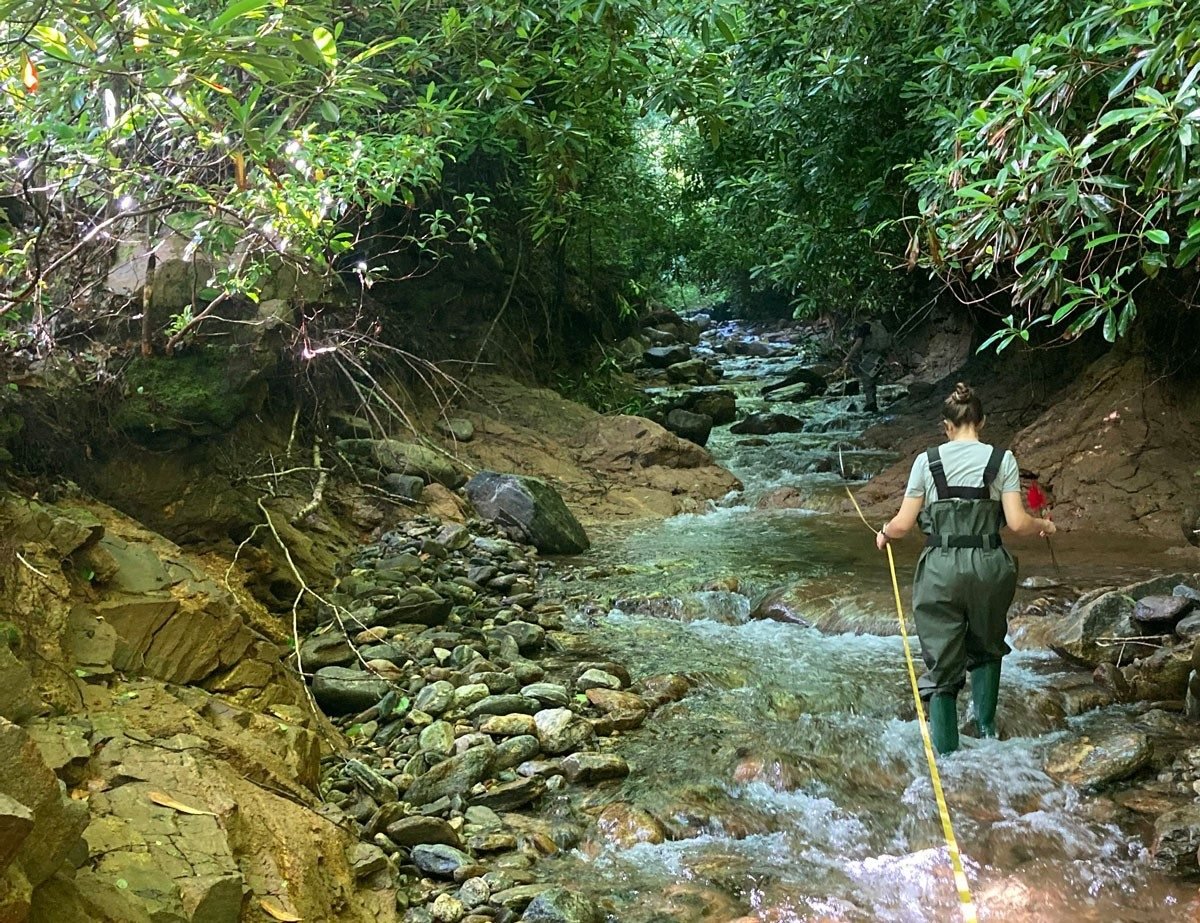
Erosion has exposed bedrock along much of Upper Allen Creek in the Waynesville Watershed Conservation Area, North Carolina. - (Photo courtesy of Nathaniel Barrett.)
What remains unknown
The researchers describe this as the first U.S. study to measure microplastic deposition before, during and after a hurricane. It offers a useful starting point, but does not establish the storm’s full microplastic footprint or the consequences for human health and wildlife.
What it does show is that remote watersheds receive pollution from the atmosphere, and a major storm can deliver a substantial share of a year’s total in a short period.
If you are interested in more details about the underlying research, be sure to check out the article published in Oxford Academic, listed below.
Sources and further reading:

Too busy to follow science news during the week? - Consider subscribing to our (free) newsletter - (Universal-Sci Weekly) - and get the 5 most interesting science articles of the week in your inbox
FEATURED ARTICLES:




Scientists may have found an explanation for one of the biggest mysteries about ʻOumuamua that baffled astronomers in 2017.