
Some worlds do not give up their secrets easily. WASP-94A b, a giant planet nearly 700 light years from Earth, is too far away to see in the familiar way we see planets in our own solar system. Astronomers cannot watch its weather roll across the sky through a telescope like a distant weather camera.
For years, clouds on planets like WASP-94A b have created a problem for scientists. They can blur the view of an atmosphere, making it harder to tell what a distant world is made of and how it formed. Now, using the James Webb Space Telescope, researchers have found a way to separate the planet’s cloudy side from its clearer one, revealing a world whose mornings and evenings look surprisingly different.
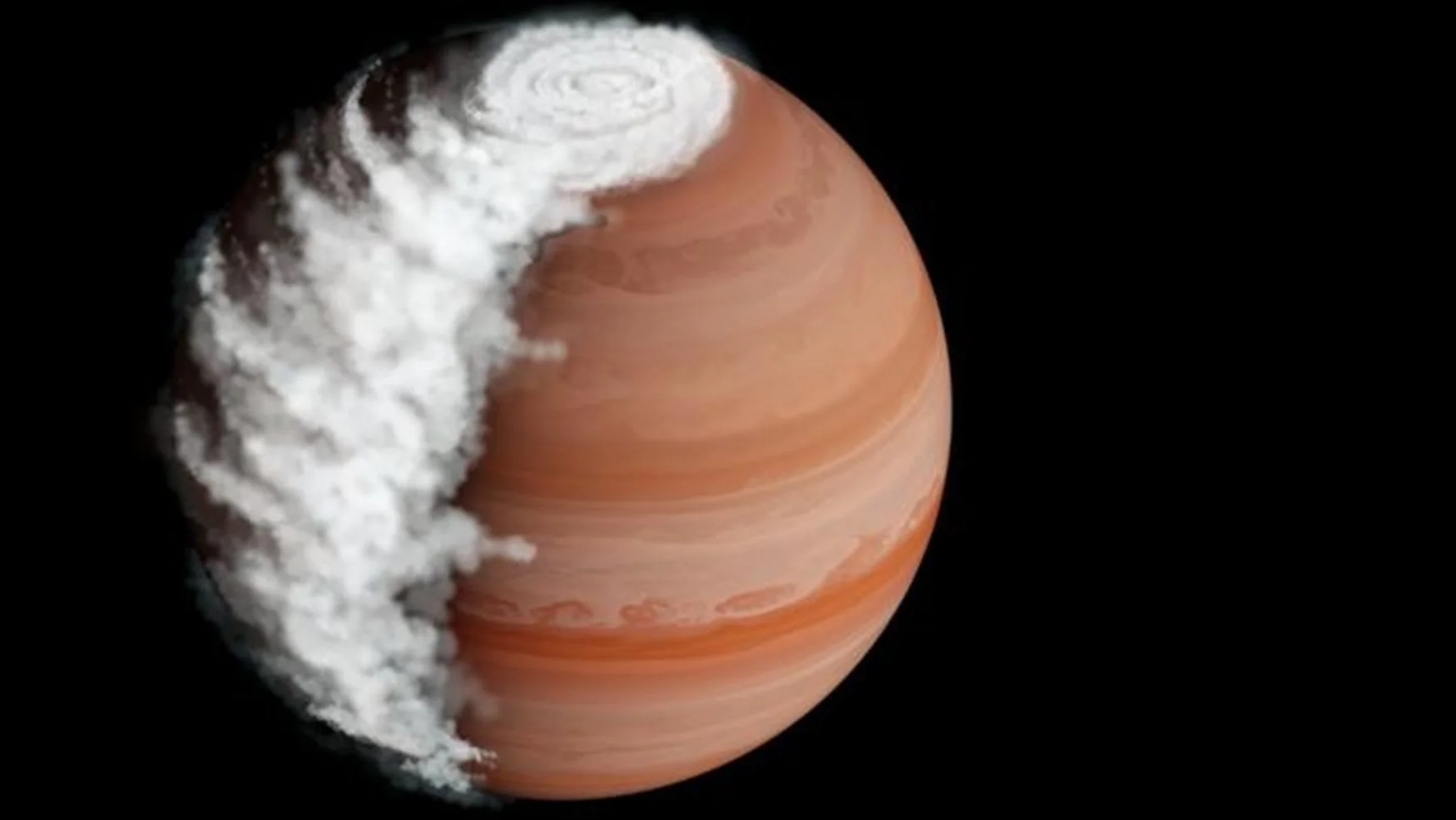
An artist’s view of WASP-94A b, where nightside winds build clouds that peak at dawn before clearing across the dayside.
Image Credit: Hannah Robbins/Johns Hopkins University
What can a cloudy planet really tell us?
WASP-94A b is a type of exoplanet known as a Hot Jupiter. These are gas giants that orbit very close to their stars, even closer than Mercury orbits the sun. That makes them extremely hot and exposed to intense radiation. For scientists, those harsh conditions are useful. They turn these planets into natural laboratories for studying how atmospheres, clouds, and chemistry behave under extremes.
But clouds have long stood in the way.
David Sing, a Bloomberg Distinguished Professor of Earth and Planetary Sciences at Johns Hopkins and co-author of the new study, put the challenge plainly: “I’ve been looking at exoplanets for 20 years, and general cloudiness has been a thorn in our side. We’ve known for quite a while that clouds are pervasive on Hot Jupiter planets, which is annoying because it’s like trying to look at the planet through a foggy window.”
That foggy window matters because astronomers study exoplanet atmospheres by watching starlight pass through them. When a planet moves in front of its star, a tiny part of the star’s light filters through the planet’s atmosphere before reaching telescopes. Different gases and particles leave clues in that light. Clouds, however, can mix those clues together or hide them.
The team studying WASP-94A b found a way to make the picture sharper.
Why morning and evening do not look the same
The key was not simply to observe the planet, but to observe different parts of it at different moments.
As WASP-94A b passed in front of its star, researchers used the James Webb Space Telescope to measure the planet’s leading edge and trailing edge separately. The leading edge is where air moves from the planet’s night side toward the day side, making it the planet’s morning. The trailing edge is where air moves from day to night, making it the evening.
That split view revealed a sharp contrast.
According to the researchers, mornings on WASP-94A b are filled with clouds made of magnesium silicate, a common mineral found in rocks. By evening, the skies appear clear.
Interesting article: Astronomers discovered there might be countless 'exo-earths' hidden from us- (Universal-Sci)
In other words, the planet’s weather changes dramatically over the course of its day. Sand-like clouds gather in the morning, then vanish by nightfall.
The researchers are considering two possible explanations. One is that powerful winds lift clouds high on the cooler side of the planet, then push them downward on the hotter dayside, burying them deep in the atmosphere where they can no longer be seen. Another possibility is more familiar, although far more extreme: the clouds may form in darkness like morning fog on Earth, then burn away as they move into daytime heat of more than 1,000 degrees.
Sing said the contrast was unexpected. “It was a huge surprise. People have expected some differences, like its cooler in the morning than the evening—that’s something natural that we experience here on Earth,” he said. “But what we saw was a real dichotomy between the weather on both sides of the planet, and huge differences in cloud coverage, and that changes our whole picture of the planet.”
How clearing the view changed the planet’s story
The clear evening skies gave astronomers something they had been missing: a cleaner look at the planet’s atmosphere.
Earlier observations from the Hubble telescope had produced a more averaged view, blending signals from clouds and atmosphere together. That made WASP-94A b look strange. The earlier data suggested the planet had hundreds of times more oxygen and carbon than Jupiter, a result that puzzled scientists because it did not fit well with theories of how planets form.
The James Webb Space Telescope changed that picture.
By focusing on the clearer evening side, the researchers found that WASP-94A b is much more like Jupiter than previously thought. Instead of having hundreds of times more oxygen and carbon, the planet appears to have about five times the amount found in Jupiter.
Sagnick Mukherjee, the study’s first author and a postdoctoral fellow at Arizona State University, explained why the new approach mattered. “With the Hubble telescope, when we used to do this type of observation, we got an average view of the whole planet with data from the clouds and the atmosphere squished together and indistinguishable,” he said. “This approach with the JWST lets us localize our observations, which helped us see the cloud cycle.”
That shift is important beyond one planet. Using WASP-94A b as a benchmark, the team also examined eight other hot gas giants and found the same kind of cloud cycle on two of them: WASP-39 b and WASP-17 b.
The results, published in Science, suggest that cloud cycles may be a key feature of some Hot Jupiter atmospheres, not just a curiosity on a single world.
The next step will be broader. Sing and his team plan to use data from a new large JWST program to study cloud cycling across a wider range of exoplanets, including an eccentric gas giant in the habitable zone.
For now, WASP-94A b offers a reminder that distant planets are not static points of light. They have weather, rhythms, and hidden patterns. Sometimes, learning what a planet is made of begins with a simpler question: what happens to its clouds between morning and evening?
If you are interestd in reading more about the underlying reaserach, be sure to check out the paper published in the peer-reviewed journal Science, listed below.
Articles and further reading:

Too busy to follow science news during the week? - Consider subscribing to our (free) newsletter - (Universal-Sci Weekly) - and get the 5 most interesting science articles of the week in your inbox
FEATURED ARTICLES:



Scientists may have found an explanation for one of the biggest mysteries about ʻOumuamua that baffled astronomers in 2017.