The Sun has produced powerful storms before, but scientists are still trying to understand just how extreme its eruptions can become. New research suggests our star may be capable of producing a superflare, a burst of radiation far more energetic than anything observed during the space age. The evidence comes from a mix of modern solar observations, centuries of sunspot records, and clues from similar stars, but one key question remains: has the Sun ever actually unleashed one?
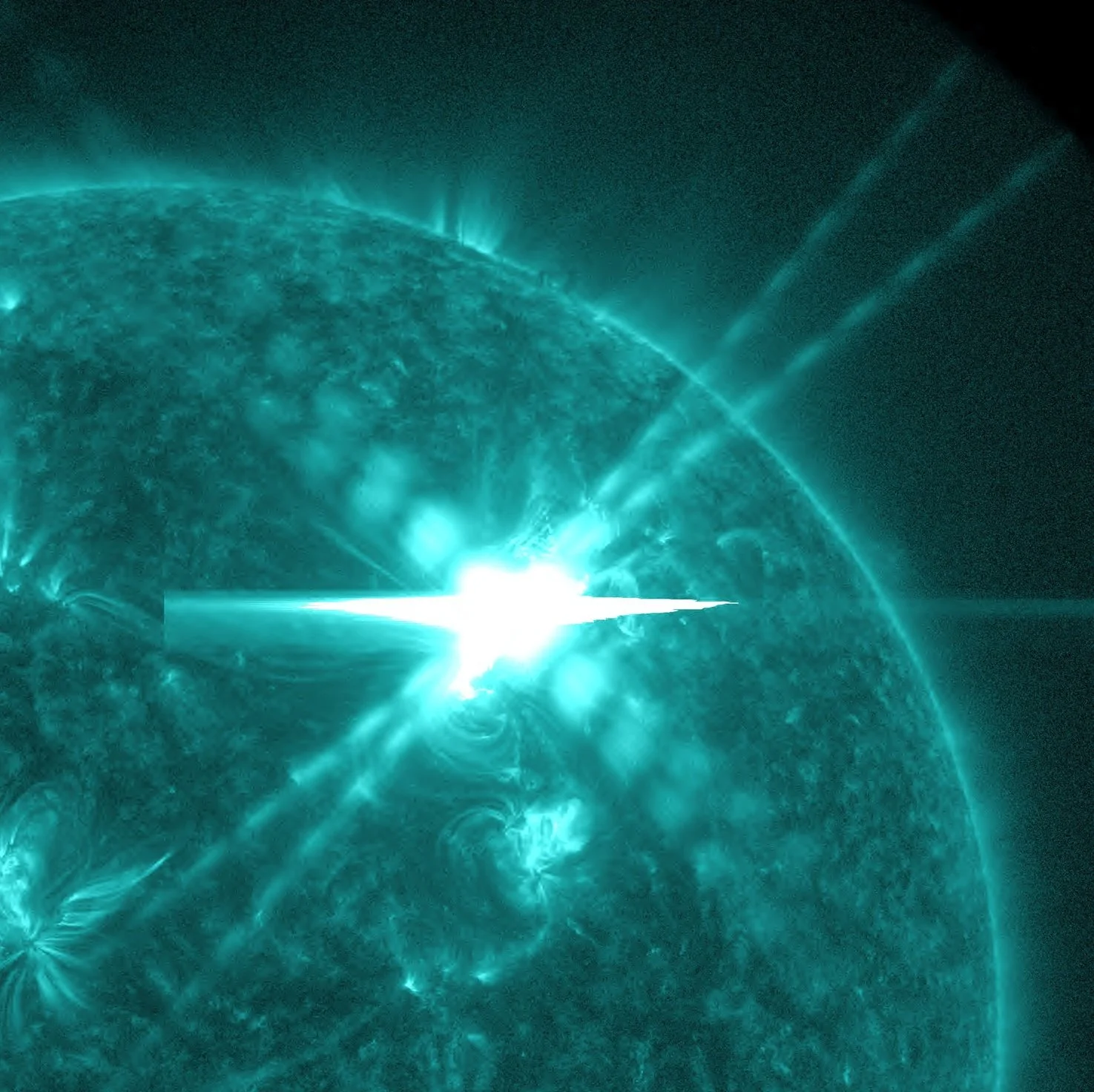
A large solar flare from back in 2012 - (Image Credit: NASA/SDO/AIA)
How do you investigate an event no one has ever seen?
Solar eruptions are hardly new. In 1859, the famous Carrington Event sent such a powerful solar storm toward Earth that auroras were seen as far south as the Caribbean, while sparks reportedly flew from telegraph receivers.
A superflare would be something more extreme. These enormous bursts of radiation can release more energy than trillions of hydrogen bombs. Astronomers have directly observed such events on distant stars, but never on the Sun.
That absence of evidence presents researchers with an obvious problem.
Scientists have only been able to measure the energy of solar flares directly, or reconstruct it in detail using observations from space, since the beginning of the space age roughly 70 years ago. No superflare has occurred during that period.
But 70 years is an extremely short sample when compared with the Sun's age of about 4.6 billion years.
"There is some evidence to suggest that the Sun, too, can produce superflares at great intervals. However, there is no direct proof", said Natalie Krivova of the Max Planck Institute for Solar System Research, lead author of the new study.
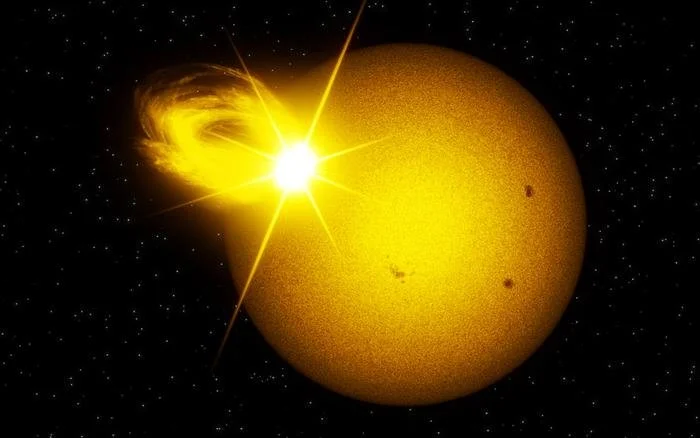
A Sun-like star experiences a superflare about once a century. - (Image Credit: MPS / Alexey Chizhik via EurekAlert)
Researchers have therefore had to search for indirect clues. One comes from other stars. In late 2024, scientists at the institute reported that superflares appear roughly once a century on stars that resemble the Sun in important ways.
Another clue is hidden in natural records on Earth. Scientists have found isolated, unusually large spikes in radioactive isotopes preserved in old tree trunks and Arctic permafrost ice cores. According to the researchers, these indicate that Earth has repeatedly been hit by exceptionally intense bursts of high-energy solar particles.
What those records cannot tell scientists is whether the particle storms arrived together with superflares. A flare, even a very powerful one, does not leave the kind of permanent physical trace that can easily be identified centuries later.
"According to the current state of research, extreme particle eruptions and particularly intense flares often - but not always - occur together", said MPS scientist Valeriy Vasilyev, lead author of a separate review on the subject.
That uncertainty led the researchers to look for another way to estimate what the Sun might be capable of.
What can 300 solar flares reveal about a much bigger one?
Instead of searching directly for a superflare that has never been observed, Krivova and her colleagues studied the relationship between ordinary solar flares and the regions that produce them.
The researchers examined observations collected by NASA's Solar Dynamics Observatory between 2010 and 2016. They focused on the 300 strongest flares recorded during that period and compared the energy released by each one with the size of the corresponding active region on the Sun.

Active regions are areas where the Sun's magnetic field is especially strong and complex. They are associated with sunspots, the darker patches that occasionally appear across the solar surface, and can become the starting points for eruptions.
The researchers found a statistical relationship between the size of an active region and the amount of energy released in a flare.
"Of course, we knew that no superflares had occurred during the observation period", Krivova said. "But the statistical relationship we found between the released energy and the size of the active region should hold true for more powerful events as well", she added.
That gave the team a way to move beyond the relatively short era of spacecraft observations.
If scientists could estimate the size of active regions from historical sunspots, they could use the relationship found in modern observations to investigate how energetic an eruption from those regions might potentially have been.
And unlike detailed measurements of solar flares, records of sunspots stretch back much further.
"Sunspots have been systematically and regularly recorded for about 400 years", said MPS researcher Theodosios Chatzistergos, a co-author of the study. Those centuries of observations contain some unusually large examples.
A giant sunspot from 1947 offers an important clue
The researchers were particularly interested in the biggest sunspots ever recorded. These rare outliers could reveal whether the Sun is capable of creating an active region large enough to produce a superflare.
One example stood out. In April 1947, one of the largest known sunspots since systematic observations began appeared on the Sun. It covered about 0.6 percent of the visible solar disk and had a diameter roughly 40 times that of Earth.
No superflare occurred. That point is important. A very large sunspot does not automatically lead to an extreme eruption.
But when the researchers applied the statistical relationship found in the modern observations, they concluded that an active region associated with a sunspot of that size could, in rare cases, produce a superflare.
"Our Sun has superflare potential. It can produce massive sunspots that, in principle, can serve as the starting point for the most extreme bursts of radiation", Krivova said.
The result does not prove that the Sun has unleashed a superflare in the past, nor does it say when one might occur. Instead, it addresses a more basic question: is the Sun physically capable of creating the kind of solar region from which such an eruption could emerge?
The study suggests that it is. That leaves researchers with an intriguing gap between possibility and proof. Observations of similar stars indicate that superflares can occur. Earth's natural archives show that unusually intense solar particle storms have happened before. And centuries of sunspot records reveal that the Sun can generate enormous active regions with the potential, at least statistically, to produce much more energetic flares.
What scientists still do not know is whether all those pieces have ever come together in a single solar superflare.
For now, that remains one of the Sun's unanswered questions. But the new research narrows the mystery: the issue may no longer be whether our star has the capacity for such an extreme event, but whether it has already happened during a chapter of solar history that humans were not able to observe.
Sources and further reading:

Too busy to follow science news during the week? - Consider subscribing to our (free) newsletter - (Universal-Sci Weekly) - and get the 5 most interesting science articles of the week in your inbox
FEATURED ARTICLES: