
Sixty-six million years ago, a dinosaur ate a bird. The meal itself vanished long ago, but one unexpected record survived: fossilized poop containing remarkably preserved feathers.
Those feathers are now giving scientists new clues about one of paleontology’s biggest mysteries. Why did one group of birds survive the asteroid-driven mass extinction when nearly all other dinosaurs, including most birds, disappeared?
A new study in Current Biology suggests part of the answer may have been hidden in the feathers themselves.
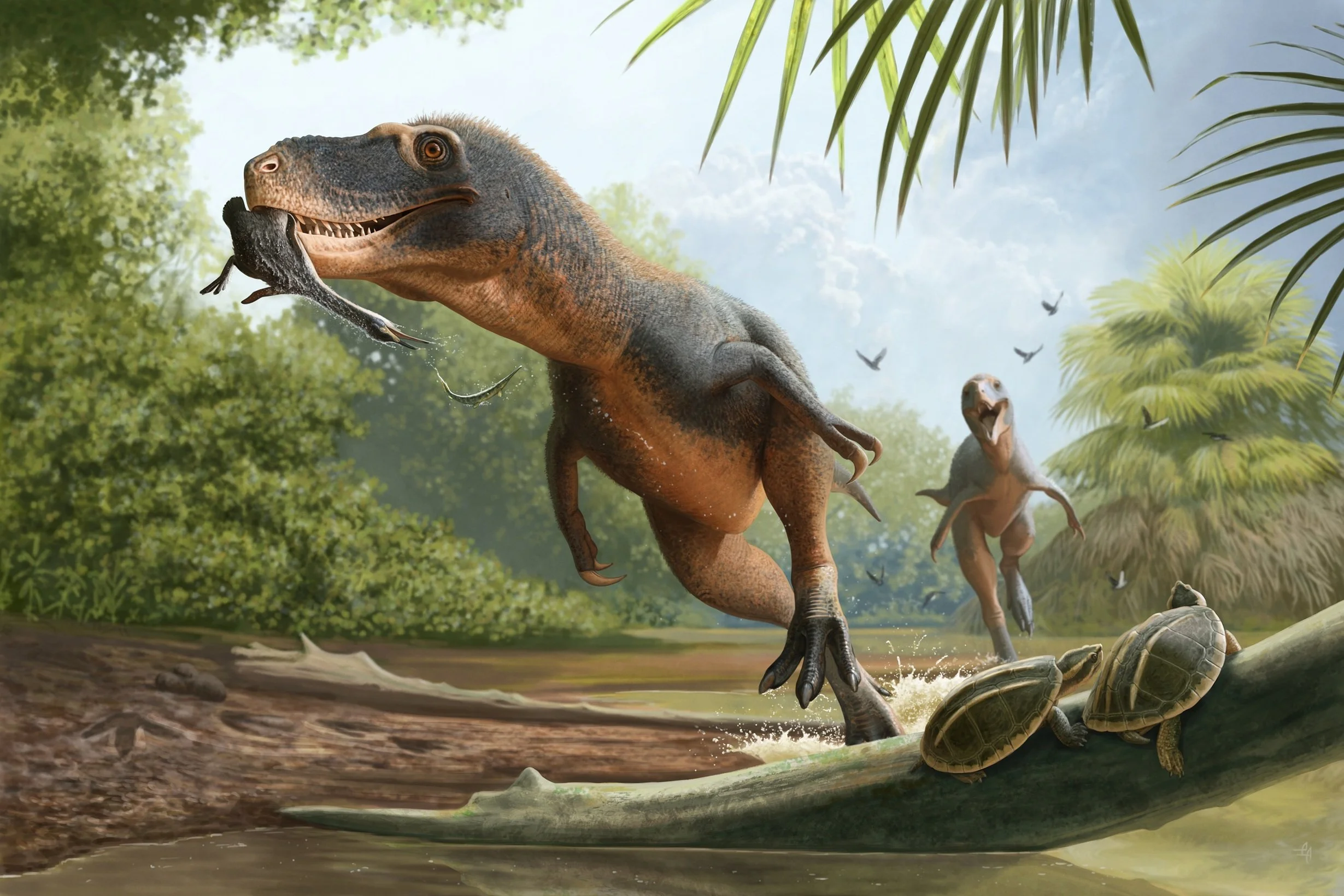
An illustration depicting a tyrannosaur preying on an ancient diving bird. - Image Credit: Andrey Atuchin via EurekAlert
What was hiding inside a small brown rock?
The fossil was discovered in 2016 by David DeMar, Jr., a research scientist and Hell Creek Project collections manager at the University of Washington Burke Museum. He was doing fieldwork in northeastern Montana when he noticed a dark, reddish-brown object about half the size of a golf ball.
Looking at its surface through a hand lens, he spotted something unexpected: a tiny fossil feather.
That alone was striking. According to DeMar, feathers had never been found in the Hell Creek Formation despite more than 150 years of fossil collecting there.
The specimen became even more interesting when researchers brought it into the lab. They examined its mineral composition and used micro-CT scanning, which combines thousands of X-ray images to build a three-dimensional picture of what is hidden inside an object.
The scans revealed that the feather visible on the outside was only the beginning.
“Every hour processing the data revealed another feather, another scale, another bone—in stunning 3D,” said study co-author Nate Carroll, a palaeontologist at the Carter County Museum in Ekalaka, Montana.
The fossil turned out to be a coprolite containing several feathers, tiny scales from a gar and leg bones belonging to a hesperornithiform bird. Because the bird bones were preserved alongside the feathers, the researchers concluded that the feathers most likely came from the same animal.
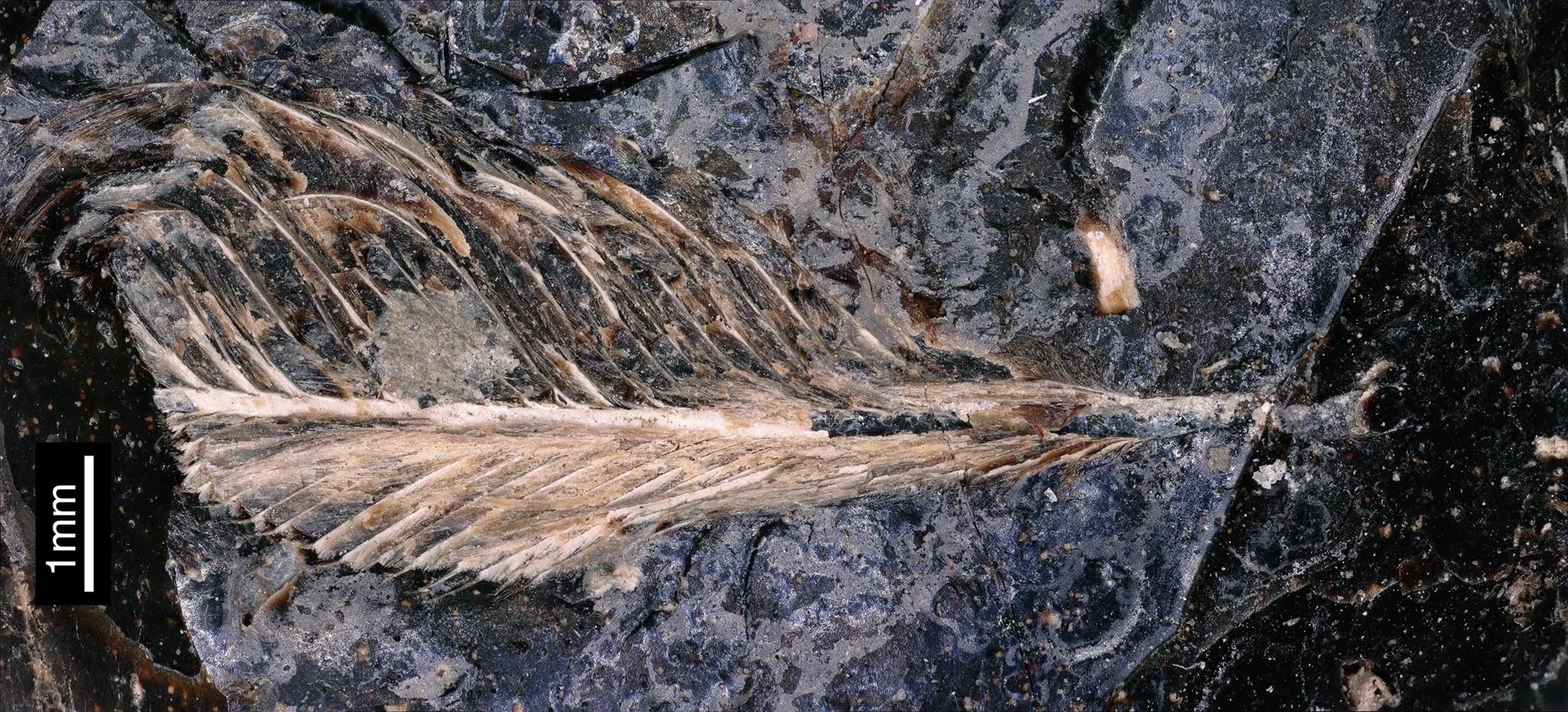
A fossil feather preserved inside dinosaur droppings. - Image Credit: O’Connor et al via EurekAlert
That meant they had something scientists had never found before: feathers from a hesperornithiform.
These birds were aquatic and, according to O’Connor, lived somewhat like modern loons. Most could not fly. Instead, they used specialized feet to dive underwater in search of prey such as fish.
But their lifestyle raised a new question.
If living near water helped birds survive, why did these birds vanish?
Birds had already existed for tens of millions of years before the asteroid impact. The earliest known bird, Archaeopteryx, lived about 150 million years ago, and many different bird groups evolved alongside other dinosaurs during the Cretaceous.
When the asteroid struck 66 million years ago, almost all of those groups disappeared.
One group, Neornithes, survived. Every bird living today belongs to the descendants of that branch.
Scientists have long tried to understand what made those survivors different. One idea has been that living near water gave some birds protection from the environmental upheaval that followed the impact.
The newly studied fossil complicates that explanation.
Hesperornithiforms were also closely associated with water, yet they became extinct. They were close relatives of Neornithes, but they were not members of that surviving group.
That suggests habitat alone cannot explain the pattern.
The feathers inside the coprolite offered another possibility.
Researchers found that some hesperornithiform feathers had features that look surprisingly modern. Their feathers included adaptations associated with aquatic life, including characteristics linked with waterproofing.
But not all of their plumage looked modern.
“Some of these diving birds’ feathers seem to have been modern-looking and water-proof, but they also had some smaller, fuzzy, primitive body feathers that we associate with dinosaurs and enantiornithines,” O’Connor said.
That combination placed the bird's plumage somewhere between the feathers of more primitive Cretaceous birds and those of modern birds.
And that difference may have mattered greatly when the climate suddenly changed.
Could the secret of survival have been warmth?
Feathers do far more than help birds fly. Body feathers also provide insulation, helping birds maintain their temperature in cold conditions.
Following the asteroid impact, Earth entered what researchers describe as an impact winter. O’Connor and her colleagues think differences in feather structure, or possibly differences in how birds replaced their feathers through molting, may have influenced which groups could cope with those conditions.
“We think the types of feathers that these birds had, and/or the way they molted those feathers, may have been one of the underlying causes of the selectivity of the end-Cretaceous mass extinction—essentially, why some birds died out and why others survived,” O’Connor said.
The idea is not simply that hesperornithiforms lacked feathers suited to water. The fossil suggests they possessed some sophisticated aquatic adaptations. Instead, the important difference may have been how effectively their body feathers trapped heat.
According to O’Connor, hesperornithiforms retained more primitive feather types that may not have provided insulation as efficiently as the plumaceous body feathers of modern birds.
If Neornithes had better insulation, that could have offered an advantage during the cold conditions that followed the impact. The finding may also help explain why other major Cretaceous bird groups, including the widespread enantiornithines, disappeared.
The evidence comes from a single unusual fossil, but its importance extends beyond feathers.
Greg Wilson Mantilla, a professor at the University of Washington and curator of vertebrate palaeontology at the Burke Museum, noted that fossils of birds are rare, and preserved feathers are rarer still. Finding feathers inside dinosaur dung also gives scientists evidence of a predator-prey interaction that took place near the end of the age of dinosaurs.
For O’Connor, the discovery is also a reminder that important evidence can come from fossils that might initially seem unremarkable.
The coprolite happened to split open in a way that exposed a feather, drawing scientists' attention to what was hidden inside. O’Connor called it “literally a lucky break.”
Now she hopes researchers will take a closer look at other fossilized droppings, particularly with CT scanning. If more coprolites contain feathers, bones or other delicate remains, they could preserve biological details that scientists have been overlooking.
A 66-million-year-old meal cannot by itself settle the question of why modern birds survived the end-Cretaceous extinction. But it adds an important piece to the puzzle. The difference between extinction and survival may not have depended only on where birds lived or what they ate. It may also have been written into something as ordinary, and as essential, as the feathers that kept them warm.
If you are interested in more details about the underlying reserach, be sure to check out the article published in Current Biology, listed below.
Sources and further reading on the topic of dionsaurs:
Bird feathers from a Late Cretaceous coprolite - (Current Biology)
Study finds that the Tyrannosaurus Rex might have had an air conditioner in its head - (Universal-Sci)
The Proto-Wing Puzzle: How Dinosaurs Shaped the Future of Flight - (Universal-Sci)
It turns out that the T. Rex must have been even more terrifying than previously thought - (Universal-Sci)


Too busy to follow science news during the week? - Consider subscribing to our (free) newsletter - (Universal-Sci Weekly) - and get the 5 most interesting science articles of the week in your inbox
FEATURED ARTICLES:




Scientists discovered that the devastating bubonic plague pandemic shaped human evolution and is still affecting our health 700 years later.