
Every morning, a gigantic cloud stretches across the Martian sky, reaching up to 1,800 kilometres before vanishing just hours later. For years, scientists struggled to explain how this mysterious cloud forms beside one of Mars’s tallest volcanoes. Now, a surprising discovery suggests that the answer lies in an atmospheric process so unusual that it has never been observed on another planet.
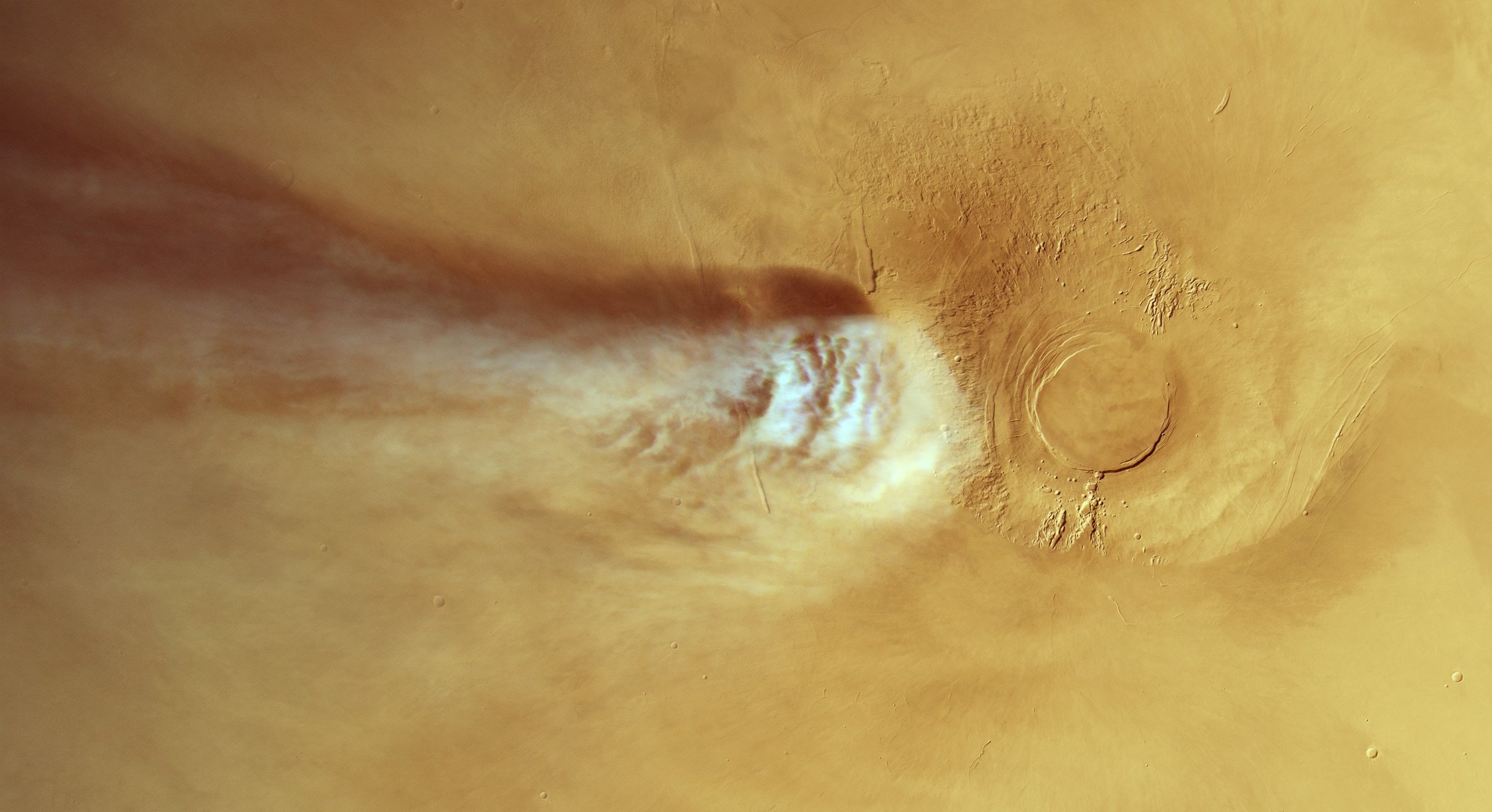
A massive cloud stretches across Mars in this image captured by ESA's Mars Express spacecraft on 24 June 2024 - (Image Credit: ESA/DLR/FU Berlin)
Why was this cloud so hard to recreate?
The cloud takes its name from Arsia Mons, the 20-kilometre-tall volcano beside which it forms. Known as the Arsia Mons Elongated Cloud, it appears during spring and summer in Mars’s southern hemisphere, coinciding with the planet’s dusty season.
Made of water ice, it can reach 1,800 kilometres in length, nearly twice the length of the UK, before quickly evaporating. The cycle repeats each morning for several months.
Researchers had already identified it as an orographic cloud. The term describes clouds that form as wind flows past a mountain or volcano, a process also seen on Earth. But that broad explanation left a crucial question unanswered: exactly how did the ice particles begin to form?
According to the research team, simulations failed to reproduce the observed cloud until they included a process generally treated as theoretical and unlikely to happen in nature.
“Once we included this physics in our simulations, the AMEC emerged just as we hoped,” says lead author Jorge Hernández-Bernal of LMD/CNRS/Sorbonne Université in Paris.
Can a cloud form without something to cling to?
Clouds usually need a little help getting started. As moist air cools, water vapour gathers on tiny particles, forming droplets or ice crystals. On Earth, those starting points can include salt, pollen, soot or dust. On Mars, scientists think dust usually plays that role.
The new modelling suggests that the Arsia Mons cloud may take a different route: water vapour forms icy particles without first gathering on another substance.
“It’s akin to droplets of condensation appearing in the middle of a room, rather than on a window,” Hernández-Bernal explains.
Scientists call this homogeneous nucleation. According to Hernández-Bernal, it has never previously been seen in a planetary atmosphere. Researchers had suggested that it might occur high above Earth and Venus, but had not spotted it.
The difficulty is creating the conditions it needs. The release describes relative humidity levels more than 100,000 times those normally experienced in everyday life on Earth.
The team’s model suggests that Mars’s thin atmosphere and the enormous height of Arsia Mons can produce those conditions together. As wind passes the volcano, it triggers a powerful wave that lifts moist air several kilometres in just a few minutes.
That rapid rise brings rapid cooling. In the model, temperatures fall by 30 degrees in 10 minutes, and relative humidity shoots up. Under those exceptional conditions, water vapour can turn directly into ice particles, giving the long white cloud its start.
How close are scientists to solving the puzzle?
The model does not match every detail of the observed cloud. Hernández-Bernal nevertheless describes its success as significant, given how much less scientists know about Mars’s atmosphere than Earth’s.
The explanation rests on modelling informed by observations from three cameras aboard Mars Express. The spacecraft is especially useful because it can observe Mars in the morning, when the cloud is present, and track changes over just a few hours.
According to ESA Mars Express Project Scientist Colin Wilson, those capabilities have allowed the mission to follow the cloud for years and help investigate its formation.
The result offers a strong possible explanation, with some details still unresolved. Its wider lesson is that understanding another planet may require taking an unlikely process seriously. Beside Arsia Mons, a cloud that returns each morning may depend on conditions that scientists rarely expect nature to provide.
If you are interested in more details about the underlying research, be sure to check out the article published in Nature Geoscience, listed below this article.
Sources and further reading:
What is the weather like on Mars? - (Universal-Sci)
How long has the ice on the Martian north pole been there? - (Universal-Sci)
Strange Martian mineral deposit likely sourced from volcanic explosions - (Universal-Sci)
Why Did Mars Turn Into a Desert? - (Universal-Sci)
Homogeneous ice nucleation from water vapour suggested by elongated clouds on Mars - (Nature Geoscience)

Too busy to follow science news during the week? - Consider subscribing to our (free) newsletter - (Universal-Sci Weekly) - and get the 5 most interesting science articles of the week in your inbox
FEATURED ARTICLES:


Scientists may have found an explanation for one of the biggest mysteries about ʻOumuamua that baffled astronomers in 2017.