
Every so often, something from beyond our Solar System passes close enough for astronomers to study. Most of the time, these objects are faint, fast-moving, and difficult to understand before they disappear back into space. - But 3I/ATLAS is different.
This interstellar comet is the brightest object of its kind ever observed, giving scientists a rare chance to examine material that did not form around our Sun. The question is not simply what 3I/ATLAS is made of. It is what its chemistry can reveal about where it came from, and how long ago that distant place existed.

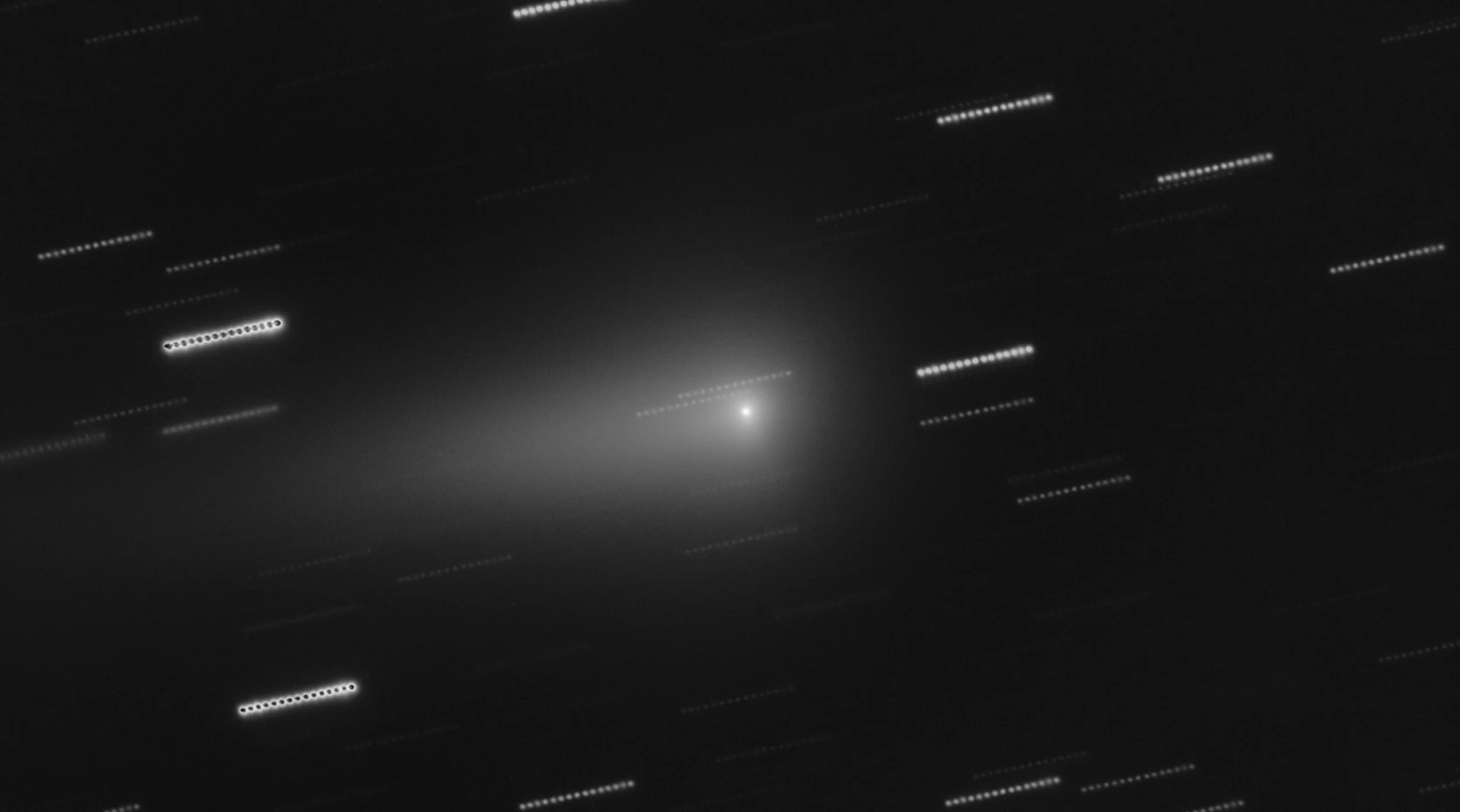
Captured on 18 January 2026 with ESO’s Very Large Telescope, this image shows interstellar comet 3I/ATLAS moving across the sky while background stars stretch into trails during the 14-minute exposure. - (Image Credit: ESO/O. Hainaut)
Using the European Southern Observatory’s Very Large Telescope, astronomers have now measured chemical fingerprints in 3I/ATLAS that had never before been observed in a comet from outside the Solar System. Those measurements point to a surprising possibility: this comet may have formed in the outskirts of an old star system, long before the Sun existed.
What Can a Passing Comet Tell Us About Another Solar System?
Interstellar comets are icy objects that formed around stars other than the Sun. Occasionally, one is sent wandering through space and passes into our Solar System. When that happens, astronomers get a brief opportunity to study material from a distant planetary system without having to travel there.
Astronomer Cyrielle Opitom, a researcher at the University of Edinburgh, described these objects as rare records of distant planetary beginnings. “They are sort of fossils from a planetary formation process that happened very far away, but that we get the chance to study from much closer,” she said.
Opitom led the new study with Jean Manfroid and Damien Hutsemékers of the University of Liège. Their work, published in Nature Astronomy, focuses on 3I/ATLAS, the third interstellar object ever discovered.
The first two were 1I/ʻOumuamua and 2I/Borisov. Both were scientifically important, but each had limits. In the case of 1I/ʻOumuamua, astronomers did not detect gas. Borisov, meanwhile, was too faint for the same kind of detailed chemical work.
3I/ATLAS offered a better chance. Because it was unusually bright and spent enough time near the Sun, astronomers could study the gas around it in much greater detail.
The Chemical Clues Hidden in Its Gas
To understand where 3I/ATLAS may have formed, the research team used the UVES instrument on ESO’s Very Large Telescope. They focused on cyanide molecules in the gas surrounding the comet and measured the ratios of carbon and nitrogen isotopes.
Isotopes are different forms of the same element. Their relative amounts can act like a chemical memory, preserving information about the environment where an object formed. According to the release, these isotope ratios are especially useful because they are sensitive to formation conditions and are not expected to change much as a comet travels through space.
The result was striking. Compared with comets from our own Solar System, 3I/ATLAS showed unusually high carbon and nitrogen isotopic ratios.
“Unlike comets from our Solar System, this interstellar visitor carries unusually high carbon and nitrogen isotopic ratios,” said Aravind Krishnakumar, a researcher at the University of Liège and co-author of the study.
The release also notes that a separate study led by Martin Cordiner at NASA’s Goddard Space Flight Center reached a related finding. That team used data from the James Webb Space Telescope and found a similar carbon isotopic ratio, along with elevated levels of deuterium, also known as heavy hydrogen.
Taken together, the studies suggest that 3I/ATLAS is not just another icy body passing through. Its chemistry appears to carry the imprint of a very different birthplace.
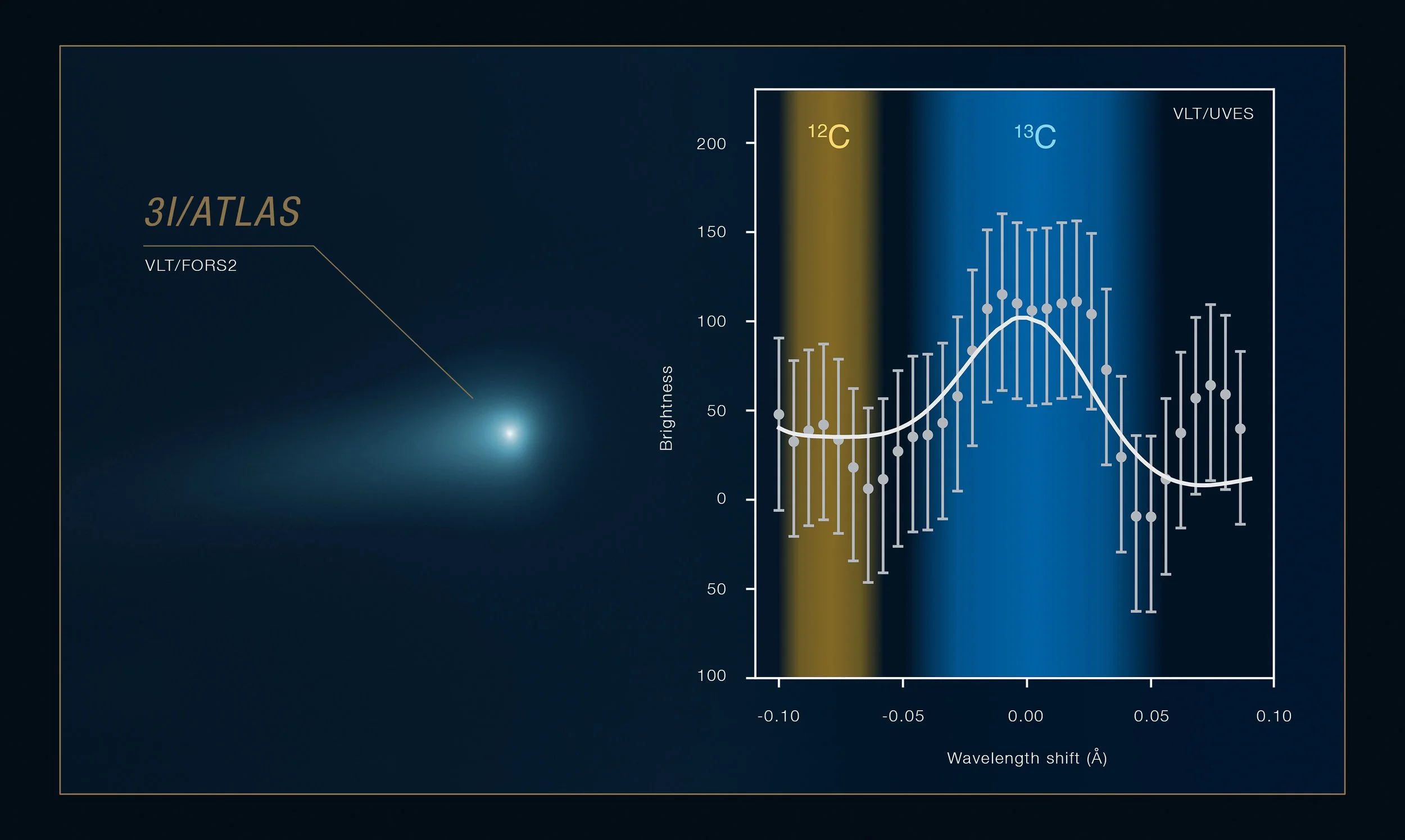
This spectrum of interstellar comet 3I/ATLAS was captured with UVES on ESO’s VLT in December 2025. By measuring faint carbon and nitrogen isotope signatures in cyanide, astronomers found clues that the comet likely formed in the outer disc of a star older than the Sun. - (Image Credit: ESO/C. Opitom, J. Manfroid et al. Comet image: O. Hainaut)
Why Its Birthplace May Have Been Much Older Than Ours
According to Opitom’s team, the evidence points to 3I/ATLAS forming in the outer regions around an old, low-metallicity star. A low-metallicity star contains relatively few elements heavier than helium. Such stars are thought to have formed when the Universe was younger and less chemically enriched than it is today.
That matters because the Sun formed from material that already contained heavier elements produced by earlier generations of stars. If 3I/ATLAS came from a low-metallicity system, it may have formed around a star much older than the Sun.
Co-author Rosemary Dorsey, a researcher at the University of Helsinki, said the comet gives scientists a rare way to study another planetary system. “3I/ATLAS is a really exciting opportunity to probe the composition of another planetary system, one that formed long before our Sun and Solar System even existed," she said.
The release says evidence from the different studies points to 3I/ATLAS being more than twice as old as the Sun. That would make this visitor not only an object from beyond our Solar System, but a possible remnant from a much earlier era of planetary formation.
For now, the window for observing it is closing. As 3I/ATLAS moves away from the Sun, it is becoming fainter, and observations with the Very Large Telescope are nearing their end.
Still, this may be the beginning of a much larger story. ESO’s upcoming Extremely Large Telescope is expected to make similar measurements possible for future interstellar objects, including ones dimmer than 3I/ATLAS.
“The field of interstellar objects is still very new, and we do not really know what to expect. Every time a new one is discovered, we have new surprises,” Opitom said.
3I/ATLAS will eventually fade from view, but the message it leaves behind is clear: small objects passing through our Solar System can carry evidence from places and times, far beyond our own cosmic neighbourhood.
If you are interested in the underlying research, be sure to check out the paper published in Nature Astronomy, listed below.
Sources, articles and further reading:
High nitrogen and carbon isotopic ratios in the interstellar comet 3I/ATLAS - (Nature Astronomy)
What Caused ʻOumuamua's Mysterious Non-Gravitational Acceleration? - We may finally have the answer - (Universal-Sci)
Interstellar travel without a spaceship is possible - (Universal-Sci)
How to build a starship – and why we should start thinking about it now - (Universal-Sci)

Too busy to follow science news during the week? - Consider subscribing to our (free) newsletter - (Universal-Sci Weekly) - and get the 5 most interesting science articles of the week in your inbox
FEATURED ARTICLES:


Scientists may have found an explanation for one of the biggest mysteries about ʻOumuamua that baffled astronomers in 2017.