Astronomers using the James Webb Space Telescope have found an object in the early universe that does not fit easily into any familiar category. It is about the size of our entire solar system and resembles an enormous star, but it produces far more energy than a star should be able to generate.
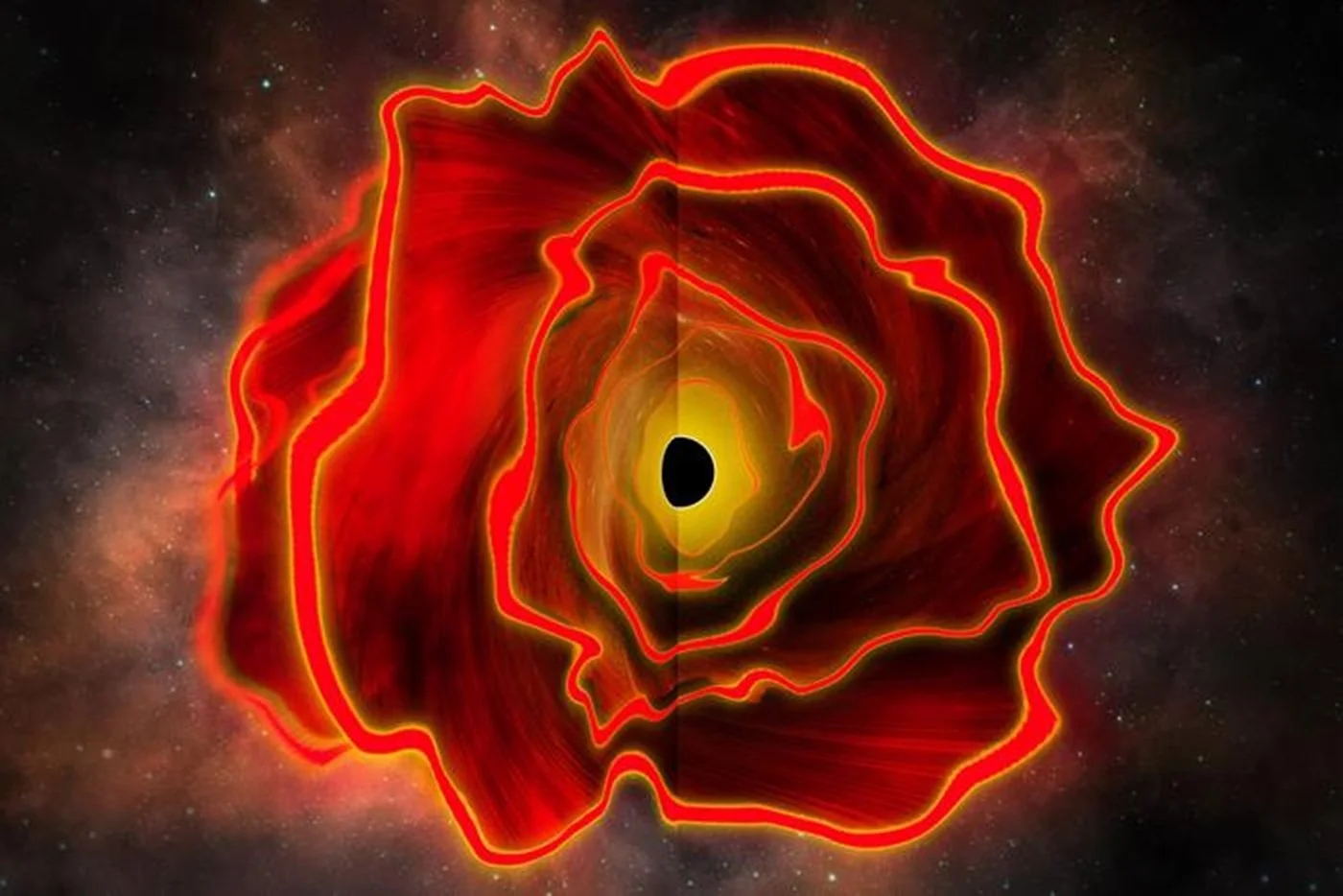
An artist impression of the newly discovered object - Image Credit: Jose-Luis Olivares, MIT
An unexpected find in a search for early galaxies
The object was discovered by astronomers at MIT and other institutions during a survey called Mirage or Miracle, or MoM. The team was using the James Webb Space Telescope, also known as JWST, to search for some of the earliest galaxies.
These galaxies appear as they existed only a few hundred million years after the Big Bang. Several surprisingly bright objects have already been found from this period, raising questions about how galaxies could have become so luminous so early.
The survey was designed to determine whether these sources really were remarkably bright young galaxies, the miracles in the project’s name, or whether some might be mirages produced by a different kind of object.
While selecting targets, the researchers noticed a point that was both unusually red and exceptionally bright. It would eventually be named MoM-BH*-1.
Why dust could not explain everything
When astronomers observe a red object, dust is often a likely cause. Dust between the object and the telescope can absorb and scatter light, making the source appear redder than it actually is.
Robert Simcoe, director of MIT’s Kavli Institute for Astrophysics and Space Research, compared the effect to wildfire smoke making the sky look red. But MoM-BH*-1 contained other signals that did not match what the researchers expected from a dusty source.
Its light remained extremely bright across much of the observed spectrum, then disappeared below certain wavelengths. This sudden drop is known as a Balmer break.
Balmer breaks are usually connected with dense gas absorbing photons in stellar atmospheres. Vega, one of the brightest stars visible in the night sky, produces the same general pattern. The break in MoM-BH*-1, however, was deeper than any previously observed.
According to lead author Rohan Naidu, a NASA Hubble Fellow and Pappalardo Fellow at MIT, the depth of the break ruled out ordinary stars as the source.
The object’s light also showed almost no signs of metals or elements other than hydrogen and helium. Together, these features suggested that the dot was not simply an ordinary galaxy hidden behind dust.
Could hydrogen produce the red color?
The researchers tested several possible explanations using computer simulations. One question was whether a source could appear so red without containing dust at all.
Their models showed that it could, provided the source was surrounded by an exceptionally dense layer of hydrogen. This layer would be less like a thin interstellar cloud and more like the surface of an enormous star.
Such a hydrogen cocoon could account for the red color, the unusually deep Balmer break, and the lack of clear signals from heavier elements. It could not, however, explain the object’s brightness.
“You have something that looks a bit like a star but is 100 billion times brighter,” Naidu said. “That means you can’t be powering this by nuclear fusion, which is the energy source that sits at the heart of all the stars we have.”
The team therefore needed an energy source capable of operating on a very different scale.
A star-like exterior with a black hole inside
The researchers added an actively accreting black hole to their simulations. They varied its mass and other properties, then compared the resulting light with JWST’s observations.
The closest match pointed to an unusual arrangement: a central black hole about 100,000 times as massive as the sun, surrounded by a dense envelope of hydrogen roughly the size of our solar system.
The outer gas would make the object resemble an enormous star. Its energy, however, would come from the central black hole rather than from nuclear fusion. The researchers call this proposed combination a black hole star.
“We think there is a central black hole that is 100,000 times as massive as the sun,” Naidu said. He explained that the black hole would be enclosed by an extended, star-like envelope of gas.
Nothing matching this combination has been observed before. Because the conclusion comes from comparing JWST data with simulations, the study presents the black hole star as the most likely explanation for MoM-BH*-1.
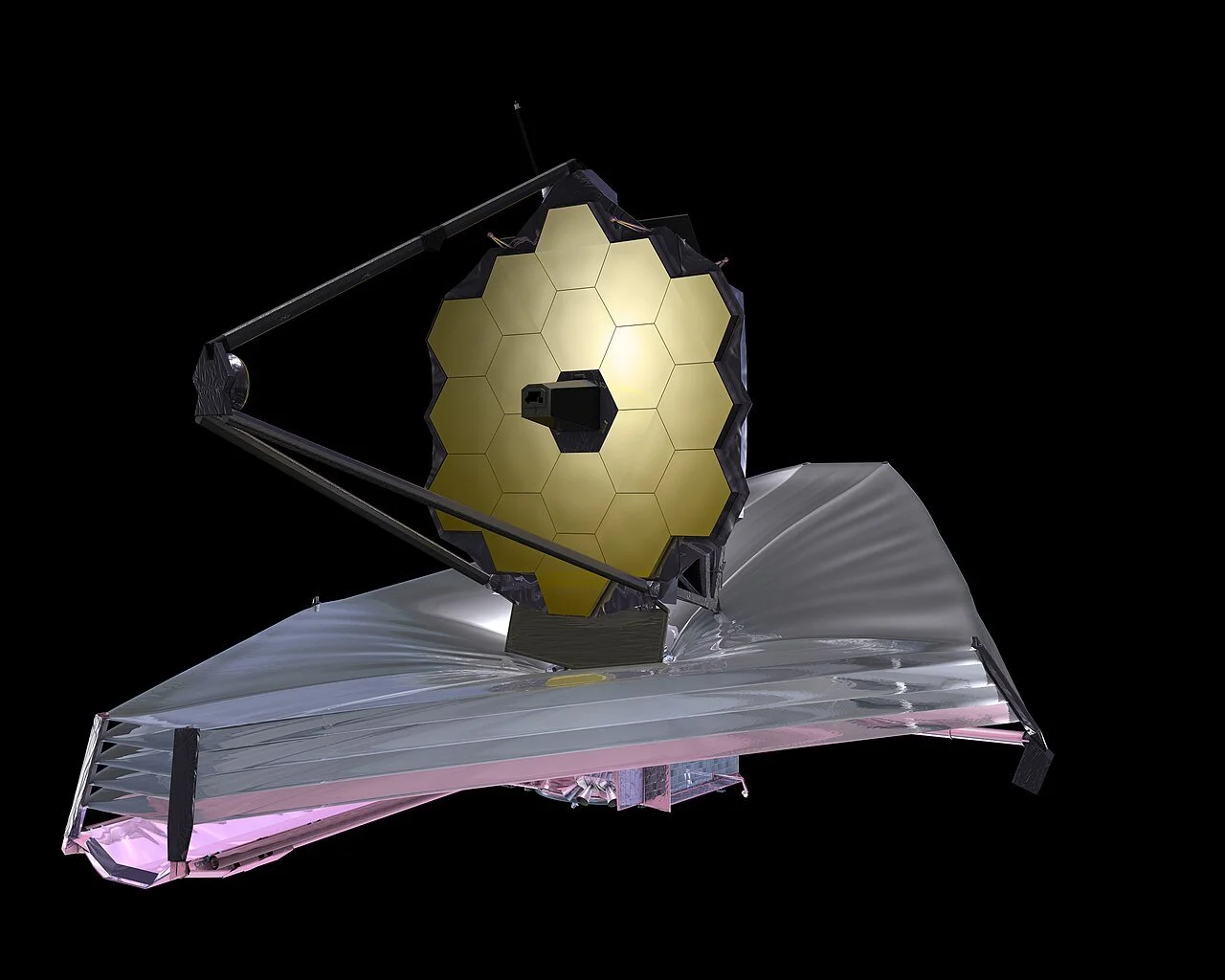
An illustration of the James Webb Space Telescope - (Image Credit: NASA)
A possible answer to a wider mystery
MoM-BH*-1 could be more than a single unusual object. It may also help astronomers understand the many other little red dots found in JWST images.
“These little red dots seem to be everywhere in the early universe but essentially disappear by the present day,” Naidu said. “What exactly these objects are has been one of the most debated topics of the JWST era.”
The researchers suspect that black hole stars could account for many of them. Naidu said the known little red dots are consistent with black hole stars embedded within early galaxies, although being consistent with the idea does not by itself prove that every dot has the same explanation.
MoM-BH*-1 is particularly useful because it is brighter than its surrounding host galaxy. Instead of the galaxy dominating the view, astronomers are seeing light that appears to come almost entirely from the proposed black hole star.
That may be why this dot offered such a clear trail of evidence. Its unusual spectrum, dense hydrogen envelope and extreme energy output all point toward the same explanation.
If that interpretation is correct, an object first noticed during a search for early galaxies may represent an entirely new astrophysical source. It could also reveal that some of the early universe’s most persistent red points are not galaxies or ordinary stars, but black holes concealed inside vast, star-like shells of gas.
If you are interested in more details about the underlying research, be sure to check out the paper listed below
Sources and further reading:
A gas-enshrouded and gas-reddened black hole at cosmic dawn - (Nature)
If the Universe Is Expanding, What Is It Expanding Into? - (Universal-Sci)
How big is the universe? - (Universal-Sci)
How could the Big Bang arise from nothing? - (Universal-Sci)
How long has gravity existed? - (Universal-Sci)
How do astronomers know the age of the planets and stars? - (Universal-Sci)

Too busy to follow science news during the week? - Consider subscribing to our (free) newsletter - (Universal-Sci Weekly) - and get the 5 most interesting science articles of the week in your inbox
FEATURED ARTICLES: