
A star’s death doesn’t necessarily destroy everything that once orbited it. Around the remains of a star called J1328−1450, astronomers have found planetary debris arranged in two separate rings. The unusual structure suggests that small planetary bodies may have survived and could still be shaping the wreckage.
According to the researchers, this system offers a glimpse of what might eventually happen to planetary systems like our own.
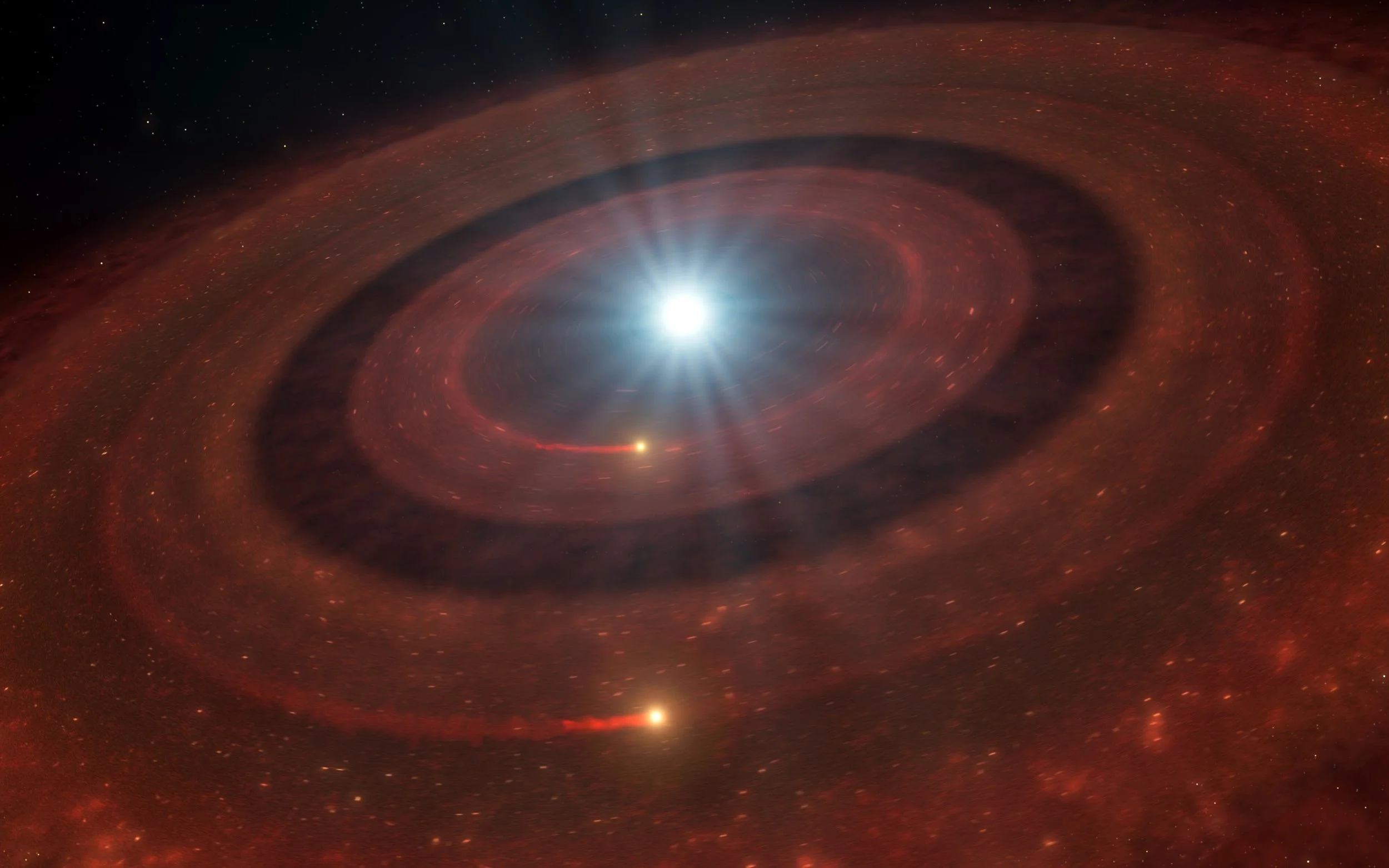
This illustration shows two rings of gas around the dead star J1328−1450, possibly maintained by two surviving planetary bodies that release gas as they interact with dust, depicted here as luminous trails. - (Image Credit: ESO/L. Calçada)
What can survive a dying star?
J1328−1450 is a white dwarf, the dense, burnt-out core left behind after a star similar to the Sun runs out of fuel.
The route to that state is destructive. As the research team explains, stars like the Sun expand near the end of their lives and shed their outer layers, engulfing nearby planets. Rocky bodies that survive can later break apart, leaving a disc of debris around the dead star.
Astronomers have found such discs before. What makes this one unusual is its arrangement: two rings of gas, one inside the other, with a clear gap between them.
“The structure we see in this system is particularly intriguing because the two gaseous rings are remarkably stable and remain separated by a gap,” says study co-author Felipe Lagos-Vilches, an astronomer at the University of Warwick and the Universidad Técnica Federico Santa María.
That separation raises a question: what is keeping the rings apart?
Are survivors holding the rings in place?
The team’s explanation points to two possible survivors moving along separate orbits.
According to the researchers, one body within the inner ring could be a few kilometres across, roughly the size of a typical asteroid. The outer body could be much larger, perhaps as big as Pluto or even our Moon. Together, they may help maintain the double-ring structure.
These bodies are a proposed explanation for the observations, rather than confirmed discoveries. Even so, the rings themselves mark a departure from the systems astronomers had previously identified.
The team studied J1328−1450 using the X-Shooter instrument on the European Southern Observatory’s Very Large Telescope in Chile’s Atacama Desert. According to the release, previously known debris discs around white dwarfs shared an observational signature indicating a single, flat, rotating disc. This system instead revealed the distinctive signature of two.
The research, led by Nicola Gentile Fusillo of the Università degli Studi di Trieste, is published in Nature Astronomy. But the rings’ arrangement is only part of the story. Their ingredients offer another clue.
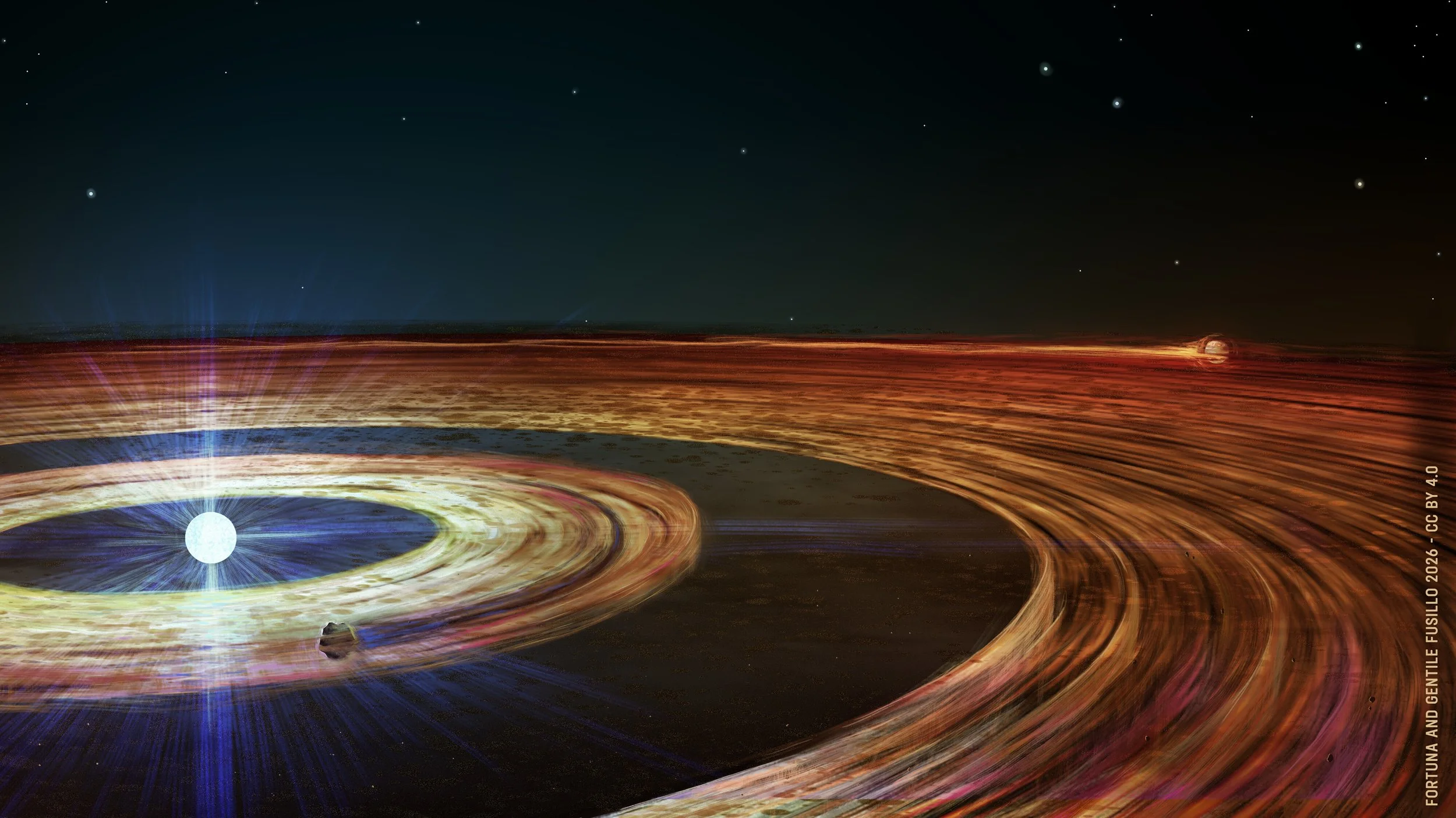
Another artist’s view of J1328−1450’s debris disc highlights the possible survivors: an inner body a few tens of kilometres wide and an outer one potentially as large as Pluto. (Image credit: Maria Cristina Fortuna) - (Image Credit: Fortuna and Gentile Fusillo - CC BY 4.0 - via ESO)
Do the rings tell two different stories?
The observations revealed calcium, oxygen, magnesium and iron in the debris. According to the team, that mixture resembles rocky planetary material in our Solar System.
Yet the two rings don’t have the same composition. The inner ring is rich in magnesium gas, while the outer ring has largely lost it.
The researchers suggest that the bodies supplying material to the rings may have come from two planets with different compositions. Another possibility is that the debris came from different parts of a single body, such as a planet’s crust and core.
Those explanations remain open. What the observations show is that the debris around a dead star can have a more complex structure than astronomers previously realised.
Our Sun will also become a white dwarf in the far future, through a process that may destroy Earth. J1328−1450 doesn’t reveal exactly how our Solar System will end. It does suggest that a star’s death can leave behind more than scattered rubble: surviving bodies may continue to shape what remains.
If you are interested in more details about the underlying research, be sure to check out he article published in nature astronomy, listed below this article.
Sources and further reading:
A double debris disc around a white dwarf sculpted by two planetary bodies - (nature astronomy)
Citizen Scientist Finds Ancient White Dwarf Star Encircled by Puzzling Rings - (Universal-Sci)
In the far Future our Sun will Turn Into a Solid Crystalline White Dwarf. Here’s How it’ll Happen - (Universal-Sci)
Curious Kids: what would happen if the sun exploded? - (Universal-Sci)
How we solved a centuries-old mystery by discovering a rare form of star collision - (Universal-Sci)
How do astronomers know the age of the planets and stars? - (Universal-Sci)

Too busy to follow science news during the week? - Consider subscribing to our (free) newsletter - (Universal-Sci Weekly) - and get the 5 most interesting science articles of the week in your inbox
FEATURED ARTICLES:




Scientists may have found an explanation for one of the biggest mysteries about ʻOumuamua that baffled astronomers in 2017.